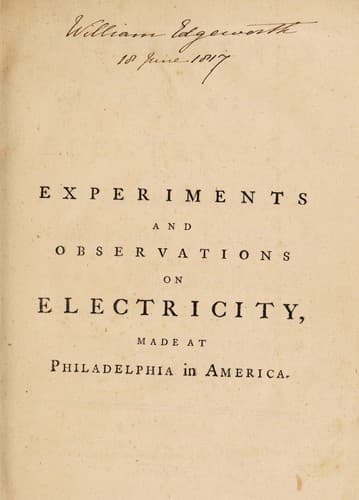
Experiments and Observations on Electricity Made at Philadelphia in AmericaFranklin, Benjamin
History
Experiments and Observations on Electricity Made at Philadelphia in America
Franklin, Benjamin
Electricity -- Early works to 1850
For just as much fire as you give the coating, so much is discharged
through the wire upon the prime conductor, whence the cork balls receive an
electrical atmosphere. But
Take a wire bent in the form of a C, with a stick of wax fixed to the
outside of the curve, to hold it by; and apply one end of this wire to the
coating, and the other at the same time to the prime conductor, the phial
will be discharged; and if the balls are not electrified before the
discharge, neither will they appear to be so after the discharge, for they
will not repel each other.
Now if the fire discharged from the inside surface of the bottle through
its wire, remained on the prime conductor, the balls would be electrified
and recede from each other.
If the phial really exploded at both ends, and discharged fire from both
coating and wire, the balls would be _more_ electrified and recede
_farther_: for none of the fire can escape, the wax handle preventing.
But if the fire, with which the inside surface is surcharged, be so much
precisely as is wanted by the outside surface, it will pass round through
the wire fixed to the wax handle, restore the equilibrium in the glass, and
make no alteration in the state of the prime conductor.
Accordingly we find, that if the prime conductor be electrified, and the
cork balls in a state of repellency before the bottle is charged, they
continue so afterwards. If not, they are not electrified by that discharge.
CORRECTIONS _and_ ADDITIONS
_to the_ PRECEDING PAPERS.
Page 2, Sect. 1. We since find, that the fire in the bottle is not
contained in the non-electric, but _in the glass_. All that is after said
of the _top_ and _bottom_ of the bottle, is true of the _inside_ and
_outside_ surfaces, and should have been so expressed. _See Sect._ 16, p.
16.
Page 6, Line 13. The equilibrium will soon be restored _but silently_, etc.
This must have been a mistake. When the bottle is full charged, the crooked
wire cannot well be brought to touch the top and bottom so quick, but that
there will be a loud spark; unless the points be sharp, without loops.
Ibid. line ult. _Outside_: add, such moisture continuing up to the cork or
wire.
Page 12, line 14. _By candle-light_ etc. From some observations since made,
I am inclined to think, that it is not the light, but the smoke or
non-electric effluvia from the candle, coal, and red-hot iron, that carry
off the electrical fire, being first attracted and then repelled.
Page 13, line 15. _Windmil wheels_, &c. We afterwards discovered, that the
afflux or efflux of the electrical fire, was not the cause of the motions
of those wheels, but various circumstances of attraction and repulsion.
Page 16, line 21. _Let_ A _and_ B _stand on wax_, &c. We soon found that it
was only necessary for one of them to stand on wax.
Page 19. in the title r. _on_.
Page 24, line 12. r. contact, line 24. confined.
Page 25, line 10. for _stand_ r. _hand_.
Public-domain text, read in full here on John Shaqi.
Reviews
Reviews
No reviews yet
Be the first to share your thoughts on this work.
Elsewhere in the archive
Join the Discussion
Join the discussion
Sign in to leave a comment or review.
Sign InorCreate an account