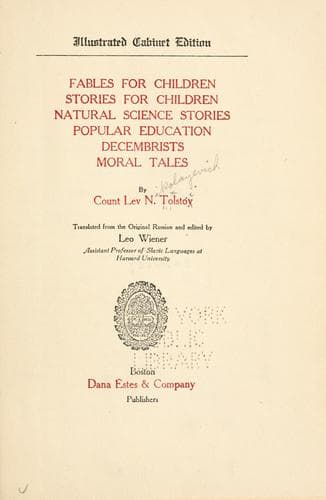
Fables for Children, Stories for Children, Natural Science Stories, Popular Education, Decembrists, Moral TalesTolstoy, Leo, graf
General
Fables for Children, Stories for Children, Natural Science Stories, Popular Education, Decembrists, Moral Tales
Tolstoy, Leo, graf
Russian literature -- Translations into English
The Tsar agreed to it, and gave them the land. The Stroganóvs sent out
clerks to gather people. And there came to them a large number of roving
people. Whoever came received from the Stroganóvs land, forest, and
cattle, and no tenant pay was collected. All they had to do was to live
and, in case of need, to go out in mass to fight the Tartars. Thus the
land was settled by the Russian people.
About twenty years passed. The Stroganóvs grew richer yet, and that
land, 140 versts around, was not enough for them. They wanted to have
more land still. About one hundred versts from them were high mountains,
the Ural Mountains, and beyond them, they had heard, there was good
land, and to that land there was no end. This land was ruled by a small
Siberian prince, Kuchum by name. In former days Kuchum had sworn
allegiance to the Russian Tsar, but later he began to rebel, and he
threatened to destroy Stroganóv's towns.
So the Stroganóvs wrote to the Tsar:
"You have given us land, and we have conquered it and turned it over to
you; now the thievish Tsarling Kuchum is rebelling against you, and
wants to take that land away and ruin us. Command us to take possession
of the land beyond the Ural Mountains; we will conquer Kuchum, and will
bring all his land under your rule."
The Tsar assented, and wrote back:
"If you have sufficient force, take the land away from Kuchum. Only do
not entice many people away from Russia."
When the Stroganóvs got that letter from the Tsar, they sent out clerks
to collect more people. And they ordered them to persuade mostly the
Cossacks from the Vólga and the Don to come. At that time many Cossacks
were roving along the Vólga and the Don. They used to gather in bands of
two, three, or six hundred men, and to select an atamán, and to row down
in barges, to capture ships and rob them, and for the winter they stayed
in little towns on the shore.
The clerks arrived at the Vólga, and there they asked who the famous
Cossacks of that region were. They were told:
"There are many Cossacks. It is impossible to live for them. There is
Míshka Cherkáshenin, and Sarý-Azmán; but there is no fiercer one than
Ermák Timoféich, the atamán. He has a thousand men, and not only the
merchants and the people are afraid of him, but even the Tsarian army
does not dare to cope with him."
And the clerks went to Ermák the atamán, and began to persuade him to go
to the Stroganóvs. Ermák received the clerks, listened to their
speeches, and promised to come with his people about the time of the
Assumption of the Blessed Virgin.
Near the holiday of the Assumption there came to the Stroganóvs six
hundred Cossacks, with their atamán, Ermák Timoféich. At first Stroganóv
sent them against the neighbouring Tartars. The Cossacks annihilated
them. Then, when nothing was doing, the Cossacks roved in the
neighbourhood and robbed.
So Stroganóv sent for Ermák, and said:
"I will not keep you any longer, if you are going to be so wanton."
But Ermák said:
Public-domain text, read in full here on John Shaqi.
Reviews
Reviews
No reviews yet
Be the first to share your thoughts on this work.
Elsewhere in the archive
Join the Discussion
Join the discussion
Sign in to leave a comment or review.
Sign InorCreate an account