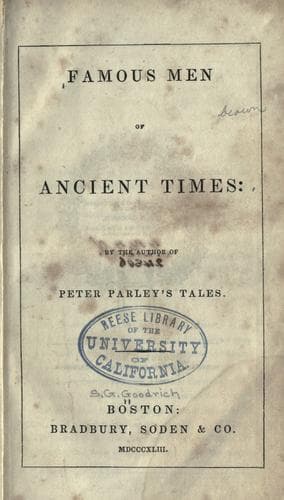
Famous Men of Ancient TimesGoodrich, Samuel G. (Samuel Griswold)
History
Famous Men of Ancient Times
Goodrich, Samuel G. (Samuel Griswold)
Biography -- Juvenile literature; Men -- Biography -- Juvenile literature
One cannot but observe, from Cicero’s pleading, the wonderful esteem
and reputation which Roscius enjoyed—of whom he draws a very amiable
picture. “Has Roscius, then,” said he, “defrauded his partner? Can such
a stain adhere to such a man, who—I speak it with confidence—has more
integrity than skill, more veracity than experience; whom the people of
Rome know to be a better man than he is an actor, and, while he makes
the first figure on the stage in his art, is worthy of the senate for
his virtues?”
His daily pay for acting is said to have been about thirty pounds
sterling. Pliny computes his yearly profit at 4000 pounds; but Cicero
seems to rate it at 5000 pounds. He was generous, benevolent, and a
contemner of money; after he had raised an ample fortune from the
stage, he devoted his talents to the public, for many years, without
pay; whence Cicero urges it as incredible that he, who in ten years
past might honestly have gained fifty thousand pounds, which he
refused, should be tempted to commit a fraud for the paltry sum of four
hundred. We need but add that the defence was effectual.
Soon after Cicero’s return to Rome, he, being about thirty years of
age, was married to Terentia, a lady of good station in life, and of
large fortune. Shortly after, he was a candidate for the office of
quæstor, in which he succeeded by the unanimous suffrage of the tribes.
The provinces of the quæstors being distributed by lot, the island
of Sicily fell to Cicero’s share. This was called the granary of the
republic, and this year, there being great scarcity at Rome, the people
were clamorous for a supply. As it was a part of the duty of the
quæstors to supply the city with corn, a difficult duty devolved upon
Cicero; for, while he was to see that Rome was adequately furnished, it
was necessary to avoid impoverishing the island. He, however, acquitted
himself with the greatest prudence and address, displaying courtesy to
the dealers, justice to the merchants, generosity to the inhabitants,
and, in short, doing all manner of good offices to everybody. He
thus obtained the love and admiration of the Sicilians, and, at his
departure, they paid him greater honors than had ever been bestowed,
even upon their own governors.
In his hours of leisure, Cicero pursued his rhetorical studies, making
it a rule never to let a day pass without some exercise of this kind.
At the expiration of his year, he left the island, and, on his return
to Rome, he stopped at Baiae, the chief seat of pleasure at that time
in Italy, and where there was a perpetual resort of the rich and great,
as well on account of its delightful situation, as for the use of its
luxurious baths and tepid waters.
Public-domain text, read in full here on John Shaqi.
Reviews
Reviews
No reviews yet
Be the first to share your thoughts on this work.
Join the Discussion
Join the discussion
Sign in to leave a comment or review.
Sign InorCreate an account