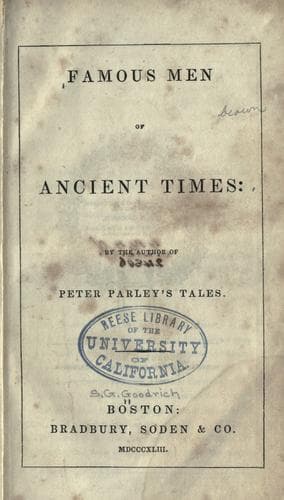
Famous Men of Ancient TimesGoodrich, Samuel G. (Samuel Griswold)
History
Famous Men of Ancient Times
Goodrich, Samuel G. (Samuel Griswold)
Biography -- Juvenile literature; Men -- Biography -- Juvenile literature
Cataline was adapted by art and nature, to be the leader of desperate
enterprises. He was of an illustrious family, of ruined fortunes,
profligate heart, undaunted courage and unwearied industry. He had a
capacity equal to the hardiest attempt, a tongue that could seduce, an
eloquence to persuade, a hand to execute. His character, compounded of
contradictory qualities—of great virtues, mastered by still greater
vices—is forcibly drawn by Cicero himself.
“Who,” said he, “was more agreeable at one time to the best citizens?
Who more intimate at another with the worst? Who a man of better
principles? Who a fouler enemy to this city? Who more intemperate in
pleasure? Who more patient in labor? Who more rapacious in plundering,
who more profuse in squandering? He had a wonderful faculty of engaging
men to his friendship and obliging them by his observance; sharing
with them in common whatever he was master of; serving them with his
money, his interest, his pains, and, when there was occasion, by the
most daring acts of villany, moulding his nature to his purposes,
and bending it every way to his will. With the morose, he could live
severely; with the free, gayly; with the old, gravely; with the young,
cheerfully; with the enterprising, audaciously; with the vicious,
luxuriously. By a temper so various and pliable, he gathered about him
the profligate and the rash from all countries; yet held attached to
him, at the same time, many brave and worthy men, by the specious show
of a pretended virtue.”
Associated in the plot with Cataline, were about thirty-five
individuals as leaders, some of them senators, and all of them men of
rank and consideration. Several were from the colonies and the larger
towns of Italy. Among the most important of these persons were Lentulus
and Cethegus, both patricians, possessing powerful family influence;
the two Syllas nephews of the dictator; Cassius, who was a competitor
with Cicero for the consulship, and Autronius, who had obtained an
election to that office, but was not permitted to hold it, on account
of his gross briberies. Julius Cæsar was suspected of being also
engaged in the scheme, but it is probable that while he was willing to
see it attempted, hoping to be benefited by the convulsion that might
follow, he was too wary to commit himself by any overt act of treason.
Public-domain text, read in full here on John Shaqi.
Reviews
Reviews
No reviews yet
Be the first to share your thoughts on this work.
Elsewhere in the archive
Join the Discussion
Join the discussion
Sign in to leave a comment or review.
Sign InorCreate an account