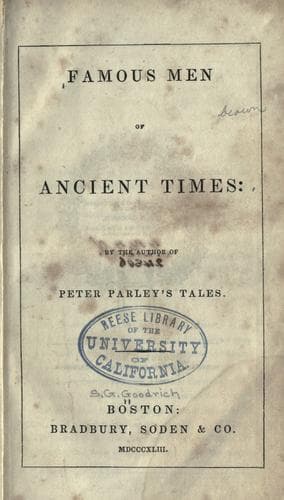
Famous Men of Ancient TimesGoodrich, Samuel G. (Samuel Griswold)
History
Famous Men of Ancient Times
Goodrich, Samuel G. (Samuel Griswold)
Biography -- Juvenile literature; Men -- Biography -- Juvenile literature
Accordingly, when Cicero had mounted the rostrum, and was about to
address the people, Metellus interfered, remarking that he who had
put citizens to death unheard, ought not to be permitted to speak for
himself. This was a reflection upon Cicero, because the associates
of Cataline had been executed by a vote of the senate, without the
ordinary trial. Cicero, however, was never at a loss, and, instead of
pronouncing the usual form of the oath, exalted his voice so that all
the people might hear him, saying, “I have saved the republic and the
city from ruin!” The vast multitude caught the sounds, and, with one
acclamation, declared, “You have sworn the truth!” Thus, the intended
affront of Metellus was turned to the advantage of Cicero, and he was
conducted from the forum to his house with every demonstration of
respect by the whole city.
It was about this period that Cicero is supposed to have pronounced his
oration, still extant, in defence of his old preceptor, Archias. He,
doubtless, expected from his muse an immortality of fame; for Archias
had sung in Greek verse the triumphs of Marius over the Cimbri, and of
Lucullus over Mithridates. He appears, however, to have died without
celebrating the consulship of Cicero; and Archias, instead of adding to
the fame of the orator, would have been buried in complete oblivion,
had not his memory been perpetuated in the immortal pages of his pupil.
Pompey the Great now returned to Rome, in the height of his fame and
fortunes, from the Mithridatic war. It had been apprehended that he
was coming back to Rome, at the head of his army, to seize upon the
government. It is certain that he had this in his power, and Cæsar,
with the tribune Metellus, was inviting him to it. But he seemed
content, for the time, with the glory he had achieved. By his victories
he had extended the boundaries of the empire into Asia, having reduced
three powerful kingdoms there, Pontus, Syria and Bithynia, to the
condition of Roman provinces, taken the city of Jerusalem, and left
the other nations of the east, as far as the Tigris, tributary to the
republic.
For these great services, a triumph was decreed him, which lasted two
days, and was the most splendid that had ever been seen in Rome. Of
the spoils, he erected a temple to Minerva, with an inscription giving
a summary of his victories:—“that he had finished a war of thirty
years; had vanquished, slain, and taken two millions one hundred and
eighty-three thousand men; sunk or taken eight hundred and forty-six
ships; reduced to the power of the empire a thousand five hundred
and thirty-eight towns and fortresses, and subdued all the countries
between the lake Moeris and the Red Sea.”
Public-domain text, read in full here on John Shaqi.
Reviews
Reviews
No reviews yet
Be the first to share your thoughts on this work.
Elsewhere in the archive
Join the Discussion
Join the discussion
Sign in to leave a comment or review.
Sign InorCreate an account