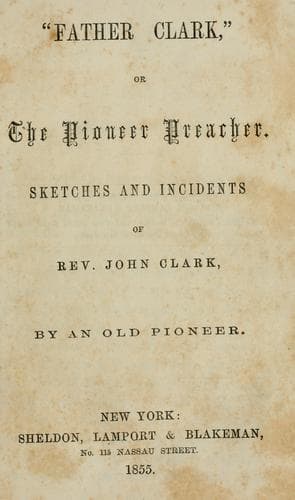
"Father Clark," or The Pioneer PreacherPeck, John Mason
History
"Father Clark," or The Pioneer Preacher
Peck, John Mason
Clark, John, 1758-1833; Methodist Episcopal Church -- Clergy
“That would only prove you to be very foolish; or, to know very
little. Suppose preachers of the Gospel should appear in our costly
and fashionable church-houses, dressed just as Jesus Christ and the
Apostles did in Judea? Would you be silly enough to laugh at them?”
“How did they dress?”
“Have you forgotten your lesson in the Biblical Antiquities, from the
Sunday-School library, you read a few weeks since? There you learn
about the dress worn in Judea.”[27]
“Why don’t our ministers dress as Jesus Christ did?”
“Because you would laugh at them. Nor would Father Clark have worn
the same dress he did in Georgia and Illinois, had he been a pastor
in Boston, New York, or Philadelphia. In such matters as were not
religious and did not pertain to the service of God, but were earthly
comforts, about which God has given no revelation, but left every one
to his own reason and common sense, Father Clark, as did Paul, would
have become ‘all things to all men.’[28] According to his notions of
propriety, the dress he wore in Georgia was convenient and comfortable.
The women who loved and respected him as a minister of Christ, made
the cloth and cut out the garments, and gave them to him in the same
form as they made for their husbands and sons; and he felt thankful
and comfortable. Besides, he preferred to live plain, and economical,
and by that means had money to give away to purchase the house and
burying-ground for the poor Africans.
“But had he received a large salary as your ministers do, or possessed
millions of property as the rich merchants, speculators, bankers, and
railroad brokers now do, he would still have dressed very plain, and
lived in such a manner as to have had the means of doing good amongst
men. I very much doubt if even the force of custom would have induced
him to appear before the people in a lugubrious garb of _black_, as
clergymen do.”
“What causes ministers to dress in _black_ clothes?”
“Doubtless because they like to be fashionable, and be noticed a little
for their distinctive dress. Some folks think black looks solemn, and
therefore suited to the clerical profession. But, after all, a solemn,
sour appearance is a species of clerical trick, which Father Clark
never would perform. He was always pleasant and cheerful, and was the
more useful for it.”
“But still I do not see why our ministers should be so fond of _black
clothes_.”
“We will answer that question, and then follow Father Clark. Black was
introduced as a clerical garb, after the church became apostate, and
was one color of the priestly garb. Probably nine-tenths of those who
have worn it, both Catholics and Protestants, have been anything else
than the true followers of Christ. An eccentric writer of a former
period, in a satire on this fashion of an ungodly priesthood, gives
this reason why they wore black as an official garb:--“_That they might
the more exactly resemble their great master Beelzebub, whose garments
are all very dingy._”
Public-domain text, read in full here on John Shaqi.
Reviews
Reviews
No reviews yet
Be the first to share your thoughts on this work.
Elsewhere in the archive
Join the Discussion
Join the discussion
Sign in to leave a comment or review.
Sign InorCreate an account