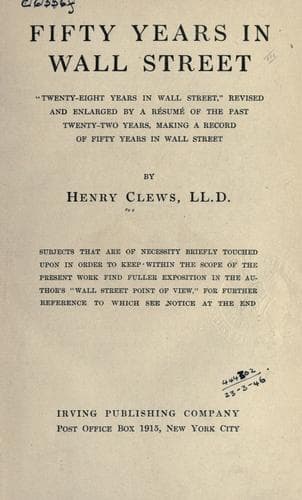
Business; Capitalists and financiers -- United States; Speculation; Wall Street (New York, N.Y.)
I shall note a few examples within the memory of newspaper readers still
living. The brief panic of 1884 brought several instances of this
character to the surface. Some of them had fought our battles for
national existence and preserved the Union when this achievement seemed
almost hopeless. Their fame as generals was as extensive as history
itself. They had planned and executed projects with success on which the
destiny of a great nation, and perhaps the destiny of other nations, had
impended, yet when they attempted to manage banks, railroads and
financial operations they became hopelessly entangled.
The great captain of the Union’s salvation was as helpless as a babe
when Ferdinand Ward and James D. Fish moved upon his works. The eye that
took in the whole situation at a glance at Vicksburg, Richmond and
Appomatox was totally unable to penetrate the insidious and speculative
designs of the “Young Napoleon of finance.”
General Grant was a victim, not so much to the sincere, veracious and
unsuspecting attributes which were so largely predominant in that great
man, as to his want of early training in financial business affairs, and
to the fact that he was unable to appreciate its necessity in dealing
with sharp business men of loose morals. Generals Winslow and Porter
fell into a similar error of judgment in the West Shore Railroad matter.
Their mistake came near being a serious blow to the railroad interests
of this country. General Wilson, of the New York and New England, and
General Gordon were similarly unfortunate. The common mistake committed
by these worthy men, to whom the country owes an inestimable debt of
gratitude, was the chief cause of the “general demoralization,” to which
Treasurer Jordan facetiously but indignantly alluded when denouncing
railroad methods, and which from time to time has played sad havoc with
some of the best securities in the country.
Therefore, I say to all who have sons destined for a business career,
let your cherished offspring have the advantage of early practical
training in the particular line of business for which you may consider
them best adapted, and do so, even to the partial neglect of their
school and college education. Practical business is the best school and
college in which they can possibly graduate. I shall attempt to make
this point clearer in another chapter.
[Illustration:
SALMON P. CHASE,
Secretary of the U. S. Treasury during the war period.
]
------------------------------------------------------------------------
CHAPTER VI.
WALL STREET DURING THE WAR.
THE FINANCIERS OF WALL STREET ASSIST THE GOVERNMENT IN THE HOUR OF THE
COUNTRY’S PERIL.—THE ISSUE OF THE TREASURY NOTES.—JAY COOKE’S
NORTHERN PACIFIC SCHEME PRECIPITATES THE PANIC OF 1873.—WALL STREET
HAS PLAYED A PROMINENT PART IN THE GREAT EVOLUTION AND PROGRESS OF
THE PRESENT AGE.
Public-domain text, read in full here on John Shaqi.
Reviews
Reviews
No reviews yet
Be the first to share your thoughts on this work.
Elsewhere in the archive
Join the Discussion
Join the discussion
Sign in to leave a comment or review.
Sign InorCreate an account