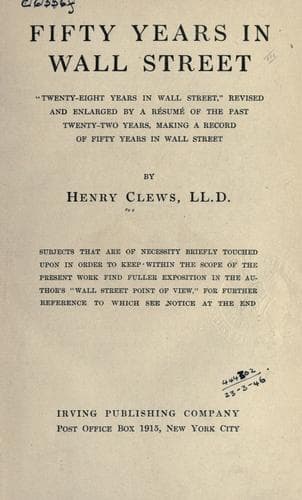
Business; Capitalists and financiers -- United States; Speculation; Wall Street (New York, N.Y.)
In this state of public feeling, Lombard Street was not in a favorable
mood to negotiate loans with this country, and, the whole fraternity of
the Rothschilds shut their fists on their shining shekels and shook
their heads negatively and ominously at the bare mention of advancing
money to the once great but now doomed Republic.
Money was dear at the time, and the Government was only obliged to pay
what could have been obtained in other quarters. Curiously enough,
private property then was considered better security than the Government
endorsement, on the principle—which was not a very patriotic one, though
in reality true—that the country could survive its form of government.
That form, however, the best the world has yet seen, survived the shock
and maintained its autonomy. That it did so was in a large measure due
to the prompt action of Wall Street men in raising the sinews of war at
the incipient stage of the rebellion. Had they failed to do so, it is
not improbable that the repulse at Bull Run might have proved a decisive
blow to the Union, and plunged the country into a state of anarchy from
which nothing but a despotism almost as bad could have retrieved it.
The negotiation of this loan brought out the twelve per cent. Treasury
notes. After this issue the rates fell. Then came the 11 and the 10¾ per
cent. issues, and subsequently the well-known and long to be remembered
7 3-10 Treasury notes.
After this issue had been popularized, successfully disposed of, and
finally taken up at maturity by the 5-20 loan, Jay Cooke was quick to
issue, after their pattern, his famous 7 3-10 Northern Pacific Railroad
bonds. Evidently he had a patent for negotiating that famous 7 3-10 per
cent. railroad loan, as almost every clergyman, Sunday-school teacher
and public benefactor were found to have invested in them, when the
crash came, and although the road was the means of his financial
downfall, with the ruin of an innumerable number of others besides, who
were dragged into the same speculative whirlpool, this unfortunate event
was not entirely an unmixed evil.
It is true that this was the main and visible cause of precipitating the
panic of 1873, of which I shall speak more fully in another chapter, but
the Pacific road was the great pioneer in opening up the Far West, and
developing its material resources, the great artery of the Western
railroad system, conveying vigorous and durable vitality to the
industrial life of the expansive regions beyond the Rockies.
Public-domain text, read in full here on John Shaqi.
Reviews
Reviews
No reviews yet
Be the first to share your thoughts on this work.
Elsewhere in the archive
Join the Discussion
Join the discussion
Sign in to leave a comment or review.
Sign InorCreate an account