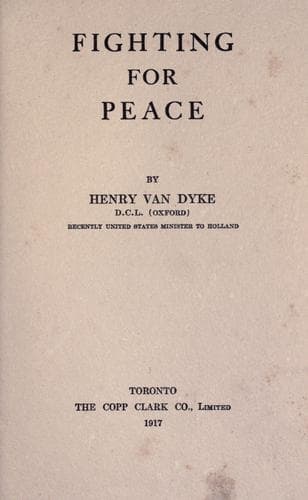
World War, 1914-1918 -- Germany; World War, 1914-1918 -- Personal narratives
"History now shows us that, neither prior to, nor at the outset of
hostilities, were people able to rely to any great extent on a neutral
Belgium, and, should we attach a certain importance to these historic
truths, we shall not, however, on the conclusion of peace, suffer
ourselves to allow of the revival of Belgium as a neutral state and
country. An independent or neutral Belgium, or a Belgium whose status
would be fixed by treaties of another kind, will be, as before the war,
under the inauspicious influence of England and France, as well as the
prey of America, who is seeking to utilize Belgian securities. There is
only one way to prevent this, viz.: by the policy of force, and it is
force that should achieve the result that the population, at present
still hostile, should become used to German rule and submit to it.
Moreover, it will be necessary, through a peace assuring us the
annexation of Belgium, that we should be able to protect, as we are now
compelled to do, the German subjects who have settled in this country,
and the protection we shall be enabled to afford them will be of special
service to us in the struggle about to take place in the world's market.
It is only by reigning over Belgium that we shall be able to utilize
(verwerten), with a view to German interests, Belgian capital in savings
and the numerous Belgian joint-stock companies already existing in enemy
countries. We ought to have control over the important enterprises that
Belgian capital has founded in Turkey, the Balkans, and China. . . ."]
[End Footnote 2]
Somewhere I have read a Latin line--the name of whose author has slipped
my memory--which seems to fit the case perfectly: "Quidquid non audet in
historia Germania mendax!" [Footnote 3]
[Footnote 3: I have taken the references which follow, as far as
possible, from Official Diplomatic Documents, edited by E. von Mach, The
Macmillan Co., New York, 1916. The comments and footnotes in this volume
are untrustworthy, but the texts are presumably correct, and it is
polite to judge the Germans from their own mouths. The book is quoted as
Off. Dip. Doc.]
II
THE AUSTRIAN ULTIMATUM TO SERVIA
In the latter part of 1916 the New York Times published an admirable
series of articles, signed "Cosmos," on The Basis of Durable
Peace.[Footnote 4] With almost every statement of this learned and able
writer I found myself in thorough accord. But the fourth sentence of the
first article I could not accept.
[Footnote 4: These articles are now published in book form by the
Scribners.]
"The question as to who or what power," writes Cosmos, "is chiefly
responsible for the last events that immediately preceded the war has
become for the moment one of merely historical interest."
Public-domain text, read in full here on John Shaqi.
Reviews
Reviews
No reviews yet
Be the first to share your thoughts on this work.
Join the Discussion
Join the discussion
Sign in to leave a comment or review.
Sign InorCreate an account