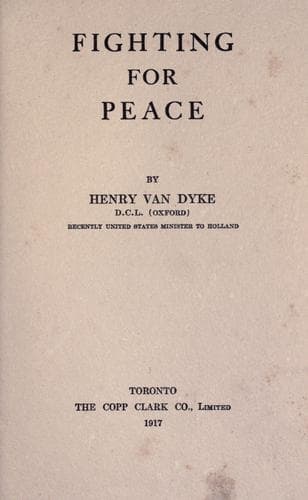
World War, 1914-1918 -- Germany; World War, 1914-1918 -- Personal narratives
On the contrary, it seems to me a question of immediate, vital, decisive
interest. It certainly determined the national action of France, Great
Britain, and Italy. They did not believe that Germany and Austria were
acting in self-defense. If that had been the case, Italy at least would
have been bound by treaty to come to the aid of her partners in the
Triple Alliance, which was purely a defensive league. But she formally
declined to do so, on the ground that "the war undertaken by Austria,
and the consequences which might result, had, in the words of the German
Ambassador himself, a directly aggressive object." (Off. Dip. Doc., p.
431.) The same ground was taken in the message of the President of the
French Republic to the Parliament on August 4, 1914 (Off. Dip. Doc., p.
444), and in the speech of the British Prime Minister, August 6, the day
on which the Parliament passed the first appropriation for expenses
arising out of the existence of a state of war (British Blue Book).
The conviction that the ruling militaristic party in Germany, abetted by
Austria, bears the moral guilt of thrusting this war upon the world as
the method of settling international difficulties which could have been
better settled by arbitration or conference, is a very real thing at the
present moment. It is shared by the Entente Allies and the United
States. It is one of those "imponderables" which, as Bismarck said long
ago, must never be left out of account in estimating national forces. It
will hold the Allies and the United States together. It will help them
to win the war for peace under conditions for Germany which may not be
"punitive," but which certainly must be "reformatory".
Understand, I do not imagine or maintain that the primary or efficient
causes of this war are to be found in any things that happened in 1914
or 1913. They are inherent in false methods of government, in false
systems of so-called national policy, in false dealing with simple human
rights and interests, in false attempts to settle natural problems on an
artificial basis.
All nations have a share in them. They go back to Austria's annexation
of Bosnia and Herzegovina in 1908; to the Congress of Berlin in 1878; to
the Franco-Prussian War in 1870; to the Prusso-Austrian War in 1866; to
the conquest of Constantinople by the Turks in 1453. Yes, they go back
further still, if you like, to the time when Cain killed Abel! That was
the first assertion of the doctrine that "might makes right."
But the "occasional cause" of this war, the ground on which it was
brought to a head and let loose by Germany, was the Austrian ultimatum
to Servia, presented on July 23, 1914, at 6 P. M.
Public-domain text, read in full here on John Shaqi.
Reviews
Reviews
No reviews yet
Be the first to share your thoughts on this work.
Join the Discussion
Join the discussion
Sign in to leave a comment or review.
Sign InorCreate an account