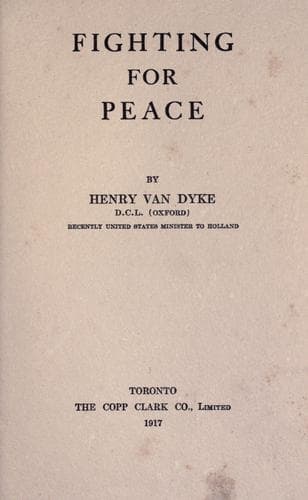
World War, 1914-1918 -- Germany; World War, 1914-1918 -- Personal narratives
(2) On July 5, 1914, it appears that a secret conference was held at
Potsdam at which high officials of the German and Austrian Governments
were present. It is not possible to give their names with certainty--not
yet, perhaps never--because these gentlemen come and go in the dark. But
the fact of the meeting was brought out publicly in the speech of Deputy
Haase in the Reichstag, July 19, 1917, and not contradicted. Whatever
may have been the ostensible object of this conference, it is impossible
to believe that the most important affairs in the world for Austria and
Germany at that moment, namely the nature of the ultimatum to Servia and
the possible eventuality of a European war, were not discussed, and
perhaps decided.
(3) On July 15, 1914, the Italian Ambassador to Turkey, Signor Garroni,
had an interview with the German Ambassador to Turkey, Baron Wangenheim,
who had just come back from a visit to Berlin. The German diplomat said
that he had been present at a conference where it had been decided that
the ultimatum to Servia was to be made of such a nature that it could
not be accepted, and that this would be the provocation of the war which
would probably ensue. Shortly afterward these statements were narrated
by Signor Garroni to Mr. Lewis Einstein, attache of the American Embassy
at Constantinople, who carefully noted them in his diary.
(4) On July 22, 1914, the British Ambassador in Berlin sent a despatch
to his Government which indicated for the first time clearly the
attitude which the German Government had decided to take. I therefore
quote it in full.
"Last night I met Secretary of State for Foreign Affairs, and the
forthcoming Austrian demarche at Belgrade was alluded to by his
Excellency in the conversation that ensued. His Excellency was evidently
of opinion that this step on Austria's part would have been made ere
this. He insisted that the question at issue was one for settlement
between Servia and Austria alone, and that there should be no
interference from outside in the discussions between those two
countries. He had therefore considered it inadvisable that the Austro-
Hungarian Government should be approached by the German Government on
the matter. He had, however, on several occasions, in conversation with
the Servian Minister, emphasized the extreme importance that
Austro-Servian relations should be put on a proper footing.
"Finally, his Excellency observed to me that for a long time past the
attitude adopted toward Servia by Austria had, in his opinion, been one
of great forbearance." (Off. Dip. Doc., p. 56.)
This shows that Germany knew what Austria was doing, approved her plan,
and had resolved that there "should be no interference from outside in
the discussion"--in other words, Germany would allow no other nation to
prevent Austria from doing what she liked to Servia. Could Germany have
taken this absolutely "committal" position if she had been ignorant of
what Austria intended to do?
Public-domain text, read in full here on John Shaqi.
Reviews
Reviews
No reviews yet
Be the first to share your thoughts on this work.
Join the Discussion
Join the discussion
Sign in to leave a comment or review.
Sign InorCreate an account