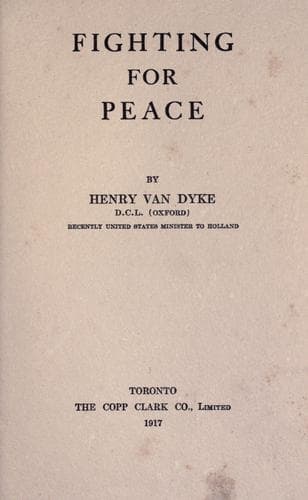
World War, 1914-1918 -- Germany; World War, 1914-1918 -- Personal narratives
This remarkable state-paper, so harsh in its tone, so imperious in its
demands, that it called forth the disapproval even of a few bold German
critics, was apparently meant to be impossible of acceptance by Servia,
and thus to serve either as the instrument for crushing the little
country which stood in the way of the "Berlin-Baghdad-Bahn," or as a
torch to kindle the great war in Europe. I do not propose to trace its
history and consequences in detail. I propose only to show, by fuller
proofs than have hitherto been available, that Germany must share the
responsibility for this flagitious and incendiary document.
On July 25, 1914, the German Ambassador at Petrograd handed an official
"note verbale" to the Russian Minister for Foreign Affairs which stated
that "The German Government had no knowledge of the text of the Austrian
note before it was presented, and exercised no influence upon its
contents." (Off. Dip. Doc., p. 173.) Similar communications were
presented in France and England.
This barefaced denial that the German Government knew what would be in
the Austrian ultimatum, or had anything to do with the framing of it,
was a palpable falsehood. It was discredited at the time. The antecedent
incredibility of the statement has been well set forth by Mr. James N.
Beck, in his vigorous book, The Evidence in the Case.[Footnote 5] New
evidence has come in. I intend here to present briefly and arrange in a
new order the facts which prove to a moral certainty that the German
Government knew beforehand what the content and intent of the Austrian
ultimatum would be, and what consequences it would probably entail.
[Footnote 5: The Evidence in the Case. Putnams. New York, 1914, pp. 31-46.]
(1) Austria was the most intimate ally of Germany, admittedly dependent
upon her big friend for backing in all international affairs. The German
Ambassador in Vienna, Herr von Tschirsky, and the Austrian Ambassador in
Berlin, Count Szogyeny, were in close consultation with the Governments
to which they were accredited during the weeks that followed the crime
of Serajevo, June 28-July 23. It is absolutely incredible that Austria
should not have consulted her big friend in regard to the momentous step
against Servia, altogether impossible that Germany should not have
insisted upon knowing what her smaller friend was doing in a matter of
such importance to them both. You might as well imagine that the board
of managers of a subsidiary railway would block out a new policy without
consulting the directors of the main line.
Public-domain text, read in full here on John Shaqi.
Reviews
Reviews
No reviews yet
Be the first to share your thoughts on this work.
Join the Discussion
Join the discussion
Sign in to leave a comment or review.
Sign InorCreate an account