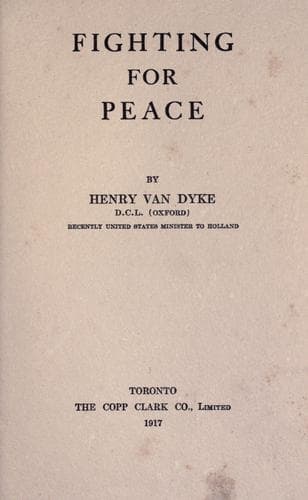
World War, 1914-1918 -- Germany; World War, 1914-1918 -- Personal narratives
On July 31, at 1 a.m., the Austrian order of complete mobilization,
which was signed on the 28th, was issued. (Off. Dip. Doc., p. 356.)
Later in the same day the Russian Government ordered complete
mobilization and the German Government proclaimed a state of
Kriegsgefahr, "wardanger." (Off. Dip. Doc., pp. 356-357.) At seven
o'clock in the evening of the same day Germany sent an ultimatum to
France, and at midnight an ultimatum to Russia.
On August 1 she declared war on Russia, and on August 3 she declared war
on France, having previously invaded French territory and sent her army
through neutral Luxembourg.
Now in all this the German Government tries to make it appear that it
was simply acting on the defensive, taking necessary steps to guard
against the peril threatened by the military measures of Russia.
The falsity of this pretense is easily shown from two facts: First, the
Russian Government was all the time pleading for a peaceful settlement
of the Austro-Servian dispute, by arbitration, or by a four-power
conference. Second, definite offers were made to halt the Russian
military measures at once on conditions most favorable to Austria, if
Austria and Germany would agree to an examination by the Great Powers of
Austria's just claims on Servia.
On the first point, I do not propose to retell the long story of the
efforts supported by France, England, Italy, and Russia herself, to get
Germany to consent to some plan, any plan, which might avert war by an
appeal to reason and justice. To these efforts Germany answered in
effect that she could not "coerce" her ally Austria.
But one document in this line seems to me particularly interesting--even
pathetic. It is a telegram sent by the late Czar Nicolas to his Imperial
Cousin, Kaiser Wilhelm. It is dated July 29, 1914, and reads as follows:
"Thanks for your telegram which is conciliatory and friendly, whereas
the official message presented to-day by your Ambassador to my Minister
was conveyed in a very different tone. I beg you to explain this
divergency. It would be right to give over the Austro-Servian problem to
The Hague Tribunal. I trust in your wisdom and friendship."
"NICOLAS."
This telegram is not contained in the "German White Book." But Professor
von Mach gives it in his "Official Diplomatic Documents" (p. 596).
I have been unable to find in any book, pamphlet, or collection of
papers a trace of the Kaiser's answer. Probably he did not send one.
On the second point I propose to quote only the three definite proposals
which were before the German Government on July 31, 1914.
Sir Edward Grey, the British Secretary for Foreign Affairs, had been
trying with the cordial help of the Russian Foreign Minister, Sazonof,
and the President of the Council of France, M. Viviani, to formulate a
plan of averting general hostilities which would meet the approval of
Germany.
Public-domain text, read in full here on John Shaqi.
Reviews
Reviews
No reviews yet
Be the first to share your thoughts on this work.
Join the Discussion
Join the discussion
Sign in to leave a comment or review.
Sign InorCreate an account