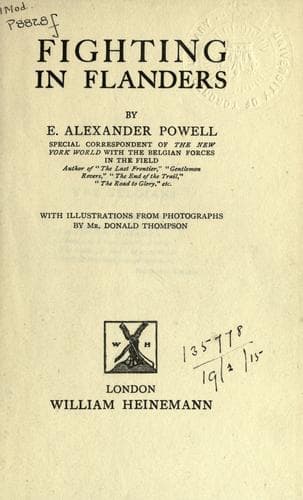
Fighting in FlandersPowell, E. Alexander (Edward Alexander)
History
Fighting in Flanders
Powell, E. Alexander (Edward Alexander)
World War, 1914-1918 -- Campaigns -- Belgium
In order to ascertain just what damage had been done to the city,
and particularly to the cathedral, I ran into Malines in my car during a
pause in the bombardment. As the streets were too narrow to permit
of turning the car around, and as it was more than probable that we
should have to get out in a hurry, Roos suggested that we run in
backward, which we did, I standing up in the tonneau, field-glasses
glued to my eyes, on the look-out for lurking Germans. I don't recall
ever having had a more eerie experience than that surreptitious visit
to Malines. The city was as silent and deserted as a cemetery;
there was not a human being to be seen; and as we cautiously
advanced through the narrow, winding streets, the vacant houses
echoed the throbbing of the motor with a racket which was positively
startling. Just as we reached the square in front of the cathedral a
German shell came shrieking over the house-tops and burst with a
shattering crash in the upper story of a building a few yards away.
The whole front of that building came crashing down about us in a
cascade of brick and plaster. We did not stay on the order of our
going. No. We went out of that town faster than any automobile
every went out of it before. We went so fast, in fact, that we struck
and killed the only remaining inhabitant. He was a large yellow dog.
Owing to strategic reasons the magnitude and significance of the
great four days' battle which was fought in mid-September between
the Belgian field army and the combined German forces in Northern
Belgium was carefully masked in all official communications at the
time, and, in the rush of later events, its importance was lost sight
of. Yet the great flanking movement of the Allies in France largely
owed its success to this determined offensive movement on the part
of the Belgians, who, as it afterwards proved, were acting in close
co-operation with the French General Staff. This unexpected sally,
which took the Germans completely by surprise, not only compelled
them to concentrate all their available forces in Belgium, but, what
was far more important, it necessitated the hasty recall of their Third
and Ninth armies, which were close to the French frontier and
whose addition to the German battle-line in France might well have
turned the scales in Germany's favour. In addition the Germans had
to bring up their Landwehr and Landsturm regiments from the south
of Brussels, and a naval division composed of fifteen thousand
sailors and marines was also engaged. It is no exaggeration, then,
to say that the success of the Allies on the Aisne was in great
measure due to the sacrifices made on this occasion by the Belgian
army. Every available man which the Germans could put into the
field was used to hold a line running through Sempst, Weerde,
Campenhout, Wespelaer, Rotselaer, and Holsbeek. The Belgians
lay to the north-east of this line, their left resting on Aerschot and
their centre at Meerbeek. Between the opposing armies stretched
Public-domain text, read in full here on John Shaqi.
Reviews
Reviews
No reviews yet
Be the first to share your thoughts on this work.
Join the Discussion
Join the discussion
Sign in to leave a comment or review.
Sign InorCreate an account