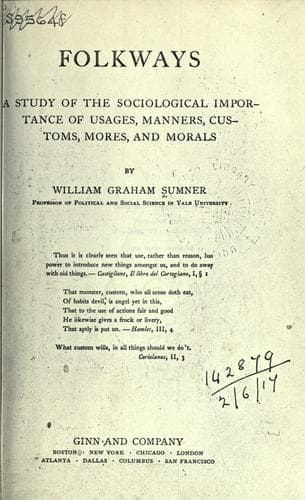
Folkways: A Study of the Sociological Importance of Usages, Manners, Customs, Mores, and MoralsSumner, William Graham
General
Folkways: A Study of the Sociological Importance of Usages, Manners, Customs, Mores, and Morals
Sumner, William Graham
Manners and customs
+45. Consistency in the mores.+ The tendency of the mores of a period to
consistency has been noticed (sec. 5). No doubt this tendency is greatly
strengthened when people are able to generalize "principles" from acts.
This explains the modern belief that principles are causative. The
passion for equality, the universal use of contract, and the sentiments
of humanitarianism are informing elements in modern society. Whence did
they come? Undoubtedly they came out of the mores into which they return
again as a principle of consistency. Respect for human life, horror at
cruelty and bloodshed, sympathy with pain, suffering, and poverty
(humanitarianism), have acted as "causes" in connection with the
abolition of slavery, the reform of the criminal law and of prisons, and
sympathy with the oppressed, but humanitarianism was a generalization
from remoter mores which were due to changes in life conditions. The
ultimate explanation of the rise of humanitarianism is the increased
power of man over nature by the acquisition of new land, and by advance
in the arts. When men ceased to crowd on each other, they were all
willing to adopt ideas and institutions which made the competition of
life easy and kindly.
+46. The mores of subgroups.+ Each class or group in a society has its
own mores. This is true of ranks, professions, industrial classes,
religious and philosophical sects, and all other subdivisions of
society. Individuals are in two or more of these groups at the same
time, so that there is compromise and neutralization. Other mores are
common to the whole society. Mores are also transmitted from one class
to another. It is necessary to give precision to the notion of classes.
+47. What are classes?+ Galton[66] made a classification of society by a
standard which he did not strictly define. He called it "their natural
gifts." It might be understood to be mental power, reputation, social
success, income from societal work, or societal value. Ammon took up the
idea and developed it, making a diagrammatic representation of it, which
is reproduced on the following page.[67]
+48.+ If we measure and classify a number of persons by any physical
characteristic (stature, weight) we find that the results always fall
under a curve of probable error. That they should do so is, in fact, a
truism. If a number of persons with different degrees of power and
resistance are acted on by the same influences, it is most probable that
the greatest number of them will reach the same and a mean degree of
self-realization, and others in proportion to their power and
resistance. The fact has been statistically verified so often, and for
such a great variety of physical traits, that we may infer its truth for
all traits of mind and character for which we have no units, and which
we cannot therefore measure or statistically classify.
Public-domain text, read in full here on John Shaqi.
Reviews
Reviews
No reviews yet
Be the first to share your thoughts on this work.
Join the Discussion
Join the discussion
Sign in to leave a comment or review.
Sign InorCreate an account