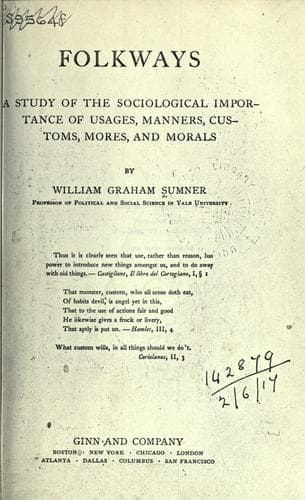
Folkways: A Study of the Sociological Importance of Usages, Manners, Customs, Mores, and Morals — John Shaqi
Folkways: A Study of the Sociological Importance of Usages, Manners, Customs, Mores, and MoralsSumner, William Graham
General
Folkways: A Study of the Sociological Importance of Usages, Manners, Customs, Mores, and Morals
Sumner, William Graham
Manners and customs
+43. Why use the word mores.+ "Ethica," in the Greek sense, or
"ethology," as above defined, would be good names for our present work.
We aim to study the ethos of groups, in order to see how it arises, its
power and influence, the modes of its operation on members of the group,
and the various attributes of it (ethica). "Ethology" is a very
unfamiliar word. It has been used for the mode of setting forth manners,
customs, and mores in satirical comedy. The Latin word "mores" seems to
be, on the whole, more practically convenient and available than any
other for our purpose, as a name for the folkways with the connotations
of right and truth in respect to welfare, embodied in them. The analysis
and definition above given show that in the mores we must recognize a
dominating force in history, constituting a condition as to what can be
done, and as to the methods which can be employed.
+44. Mores are a directive force.+ Of course the view which has been
stated is antagonistic to the view that philosophy and ethics furnish
creative and determining forces in society and history. That view comes
down to us from the Greek philosophy and it has now prevailed so long
that all current discussion conforms to it. Philosophy and ethics are
pursued as independent disciplines, and the results are brought to the
science of society and to statesmanship and legislation as authoritative
dicta. We also have _Voelkerpsychologie_, _Sozialpolitik_, and other
intermediate forms which show the struggle of metaphysics to retain
control of the science of society. The "historic sense," the
_Zeitgeist_, and other terms of similar import are partial recognitions
of the mores and their importance in the science of society. It can be
seen also that philosophy and ethics are products of the folkways. They
are taken out of the mores, but are never original and creative; they
are secondary and derived. They often interfere in the second stage of
the sequence,--act, thought, act. Then they produce harm, but some
ground is furnished for the claim that they are creative or at least
regulative. In fact, the real process in great bodies of men is not one
of deduction from any great principle of philosophy or ethics. It is one
of minute efforts to live well under existing conditions, which efforts
are repeated indefinitely by great numbers, getting strength from habit
and from the fellowship of united action. The resultant folkways become
coercive. All are forced to conform, and the folkways dominate the
societal life. Then they seem true and right, and arise into mores as
the norm of welfare. Thence are produced faiths, ideas, doctrines,
religions, and philosophies, according to the stage of civilization and
the fashions of reflection and generalization.
Public-domain text, read in full here on John Shaqi.
Reviews
Reviews
No reviews yet
Be the first to share your thoughts on this work.
Join the Discussion
Join the discussion
Sign in to leave a comment or review.
Sign InorCreate an account