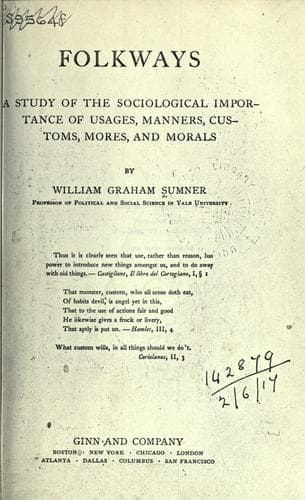
Folkways: A Study of the Sociological Importance of Usages, Manners, Customs, Mores, and MoralsSumner, William Graham
General
Folkways: A Study of the Sociological Importance of Usages, Manners, Customs, Mores, and Morals
Sumner, William Graham
Manners and customs
+59. Agitation.+ Every impulse given to the masses is, in its nature,
spasmodic and transitory. No systematic enterprise to enlighten the
masses ever can be carried out. Campaigns of education contain a
fallacy. Education takes time. It cannot be treated as subsidiary for a
lifetime and then be made the chief business for six months with the
desired result. A campaign of education is undemocratic. It implies that
some one is teacher and somebody else pupil. It can only result in the
elucidation of popular interests and the firmer establishment of popular
prejudice. On the other hand, an agitation which appeals skillfully to
pet notions and to latent fanaticism may stampede the masses. The Middle
Ages furnished a number of cases. The Mahdis who have arisen in
Mohammedan Africa, and other Moslem prophets, have produced wonderful
phenomena of this kind. The silver agitation was begun, in 1878, by a
systematic effort of three or four newspapers in the middle West,
addressed to currency notions which the greenback proposition had
popularized. What is the limit to the possibilities of fanaticism and
frenzy which might be produced in any society by agitation skillfully
addressed to the fallacies and passions of the masses? The answer lies
in the mores, which determine the degree of reserved common sense, and
the habit of observing measure and method, to which the masses have been
accustomed. It follows that popular agitation is a desperate and
doubtful method. The masses, as the great popular jury which, at last,
by adoption or rejection, decides the fate of all proposed changes in
the mores, needs stability and moderation. Popular agitation introduces
into the masses initiative and creative functions which destroy its
judgment and call for quite other qualities.
Public-domain text, read in full here on John Shaqi.
Reviews
Reviews
No reviews yet
Be the first to share your thoughts on this work.
Elsewhere in the archive
Join the Discussion
Join the discussion
Sign in to leave a comment or review.
Sign InorCreate an account