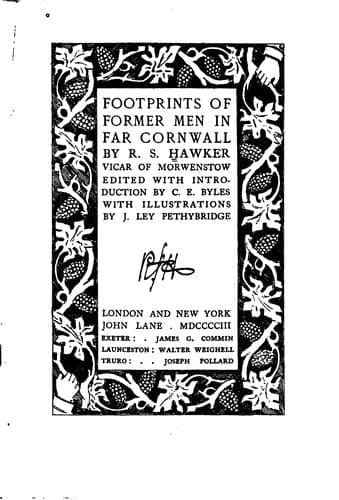
Footprints of Former Men in Far CornwallHawker, Robert Stephen
History
Footprints of Former Men in Far Cornwall
Hawker, Robert Stephen
Cornwall (England : County) -- History
“Nunc scio quid sit amor, duris in cotibus illum”
“Now know I what true love is; in rugged dens he dwells.”
Here the wedded pair dwelt in peace long and happy years, mingling
the imagery of old romance with the sterner duties of practical life.
As a far-famed hewer of stone, the skill and energy of this singular
man never lacked employ, nor failed to supply the necessities of his
moorland abode. Like a patriarch in his tent amid the solitudes of
Syria, he was his own king, prophet, and priest. He paid neither rent,
nor taxes, nor tithe. When children were born to him, he exercised
unwittingly the power of lay-baptism which was granted in the primitive
Church to the inhabitants of a wilderness, afar from the ministry of
the priesthood, and his wife was content to be “churched” by her own
cherished husband, among the altars of unhewn stone that surrounded
their solitary cell. Who shall say that this simple worship of the
father and the mother with their household, amid the paradise of hills,
was not as sweet, with the balsam of the soul, as the incense-breathing
psalm of the cathedral choir? Rightly or wrongly, it is known that
Daniel entertained an infinite contempt for “the parsons” whose
territories bordered on the moor. Not one of them, it was his wont to
aver, could cross the Asses’ Bridge of his favourite Euclid, a feat
he had himself accomplished in very early youth; nor could the most
learned among them all unravel the mysteries of his chosen companions,
the wandering stars that travelled over Carradon every night. Long
and frequent were his vigils for astronomical researches and delight.
To this day the traveller will encounter on the face of some solitary
rock a mathematical diagram carefully carved by some chisel and hand
unknown; and while speculation has often been rife as to the Druidical
origin of the mystic figure, or the scientific knowledge of the early
Kelts, the local antiquary is aware that these are the simple records
of the patient studies of Daniel Gumb.
When the writer of this article visited the neighbourhood in 183-,
there still survived relics and remembrances of this singular man.
There were a few written fragments[74] of his thoughts and studies
still treasured up in the existing families of himself and his wife.
Here is a transcript: “Mr. Cookworthy told me, when I saw him last,
that astronomers in foreign parts, and our great man Sir Isaac here at
home, had thought that the planets were so vast, and so like our earth
in their ways, that they might have been inhabited by men; but he said,
‘their elements and atmosphere are thought to be unfit for human life
and breath.’ But surely God would not have so wasted His worlds as to
have made such great bright masses of His creation to roll along all
barren, as it were, like desert places of light in the sky. There must
be people of some kind there: how I should like to see them, and to go
there when I die!”
Public-domain text, read in full here on John Shaqi.
Reviews
Reviews
No reviews yet
Be the first to share your thoughts on this work.
Join the Discussion
Join the discussion
Sign in to leave a comment or review.
Sign InorCreate an account