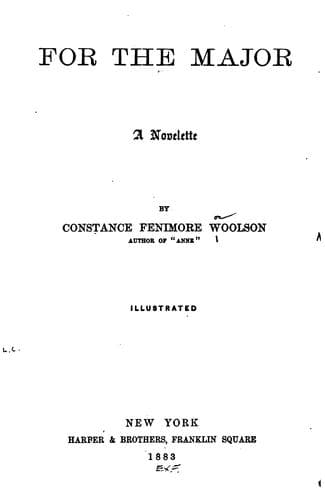
For the Major: A NoveletteWoolson, Constance Fenimore
General
For the Major: A Novelette
Woolson, Constance Fenimore
Psychological fiction; United States -- Social life and customs -- 19th century -- Fiction
"I think--I think, with your permission, we will go to another room,"
said the clergyman.
Miss Carroll was still standing; she made no offer to go. Again she
looked at their visitor, and this time it seemed to him that it was more
than guardedly, that it was defiance. "Mamma," she said, "with your
headache--for I know you have it still--are you not undertaking too
much? Mr. Owen will excuse you. Or could I not take your place?" And
she turned to Owen.
"No," he answered; "you could not." And he said no more. He was aware
that he was proceeding clumsily, but he could not help it. He found that
he cared too much about it to do it gracefully or with skill. He
recalled her slender, black-robed figure going towards the fir-wood, and
his eyes grew more clouded than before. He turned away. "Of course, if
Madam Carroll is suffering," he said--then he stopped; he did not want
to postpone it again.
Madam Carroll threw up her hands. "My dear Sara, you make so much of my
poor little headache that Mr. Owen will think I am subject to headaches.
But I am happy to say that I am not; as a general thing, they are mere
feminine affectations. Come to the drawing-room, Mr. Owen. At this hour
we shall not be interrupted." She led the way thither, and seated
herself in her favorite chair, having first rolled forward a larger one
for her guest. The spindle-legged furniture of the old-fashioned room
had been covered by her own deft fingers with chintz of cream-color,
enlivened with wreaths of bright flowers; over the windows and doors
hung curtains of the same material. In this garden-like expanse Owen
took his seat, collected himself and what he had to say in one quick
moment of review, and then began.
First, he asked her to pardon what was, in one way, the great liberty he
was taking in speaking at all; in excuse he could only say that it
seemed to him important--important to her own household. And in no
household the world held had he a deeper, a more sincere, interest than
in her own.
Madam Carroll begged to recall to his remembrance that that was saying a
great deal--"no household in the world."
He did not answer this little speech, archly made. He took up his main
subject. He told her that he had been unwilling to speak to her of it at
all; that he should have greatly preferred speaking to the Major; but
that had not been possible, at least for the present, as she was aware.
The matter concerned itself with some facts he had lately learned about
a person who had been generally received in Far Edgerley and also at the
Farms--a person of whose history they really knew nothing, this--this
musician--
"Are you pretending you do not know his name?" asked Madam Carroll. "I
can tell you what it is if you have forgotten; it will make your story
easier: Dupont--Louis Eugene Dupont."
Public-domain text, read in full here on John Shaqi.
Reviews
Reviews
No reviews yet
Be the first to share your thoughts on this work.
Join the Discussion
Join the discussion
Sign in to leave a comment or review.
Sign InorCreate an account