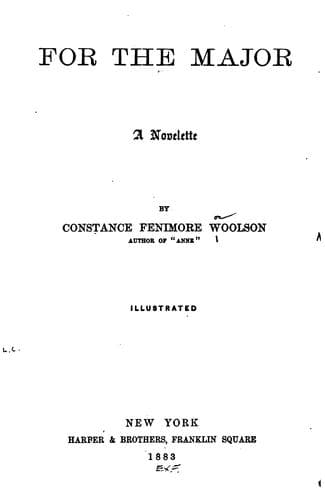
For the Major: A NoveletteWoolson, Constance Fenimore
General
For the Major: A Novelette
Woolson, Constance Fenimore
Psychological fiction; United States -- Social life and customs -- 19th century -- Fiction
The young clergyman was struck into silence. This little, gentle,
golden-haired lady, whom he had admired so long and so sincerely, was
this she? Were those her words? Was that her laugh? It seemed to him as
if some evil spirit had suddenly taken up his abode in her, and having
driven out her own sweet soul, was looking at him through her pretty
eyes, and speaking to him with her pretty, rose-leaf lips. Stinging,
under the circumstances insulting, as had been her speech, he was not
angry; he was too much grieved. He could have taken her in his arms and
wept over her. For what could it all mean save that Dupont had in some
way obtained such control of her, poor little woman, that she was ready
to attack everybody and anybody who attacked him?
He looked at her, still in silence. Then he rose. "I have told you all I
know, Madam Carroll," he said, sadly, taking his hat from the chair
beside him. "I had hoped that you would--I never dreamed that you could
receive me or speak to me in the way you have. I have had the greatest
regard for you; I have thought you my best friend."
Madam Carroll had also risen, with the air of wishing to close the
interview. She dropped her eyes as he said these last words, and lifted
her handkerchief to her mouth.
"I think as much of you as ever," she murmured. And then she began to
cough, a cough with a long following breath that was almost like a sob.
The door opened, and Sara Carroll entered. She came straight to her
mother, and put her arm round her as if to support her. "I knew you were
not well, mamma. Mr. Owen will certainly excuse you _now_" And she
looked at their guest with a glance which he felt to be dismissal.
Madam Carroll, exhausted by the cough, leaned against her daughter, her
face covered by her handkerchief. Owen turned to go. But when he saw the
daughter standing there so near him, when he thought of what he knew of
her interest in this man, and of the mother's recent tone about him, his
heart failed him. He could not go--go and leave her without one word of
warning, one effort to save her, to show her what he felt.
"I came to warn Madam Carroll against Louis Dupont," he said, abruptly.
"Madam Carroll has not credited what I have said, or, rather, she is not
impressed by it. Yet it is all true. And probably there is much more. He
is not a person with whom you should have intimate acquaintance, or,
indeed, any acquaintance. As Madam Carroll will not do so, will you let
_me_ warn you?"
Miss Carroll started slightly as he said this. Then she recovered
herself. "Surely it is nothing to me," she said, indifferently, with a
slight emphasis on the "me."
Owen watched the indifferent expression. "She is acting," he thought.
"She does it well!" Then aloud, "On the contrary, I suppose it to be a
great deal to you," he answered, his eyes, intent and sorrowful, fixed
full upon her over the little mother's head.
Public-domain text, read in full here on John Shaqi.
Reviews
Reviews
No reviews yet
Be the first to share your thoughts on this work.
Elsewhere in the archive
Join the Discussion
Join the discussion
Sign in to leave a comment or review.
Sign InorCreate an account