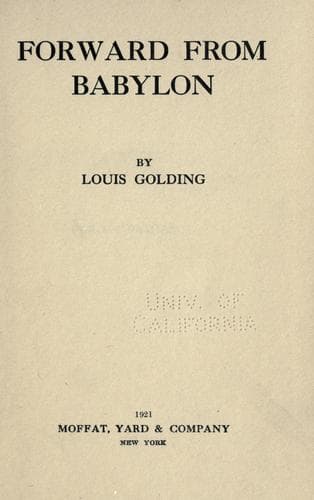
England, Northern -- Fiction; Fathers and sons -- Fiction; Jews -- Fiction
wasn't really cheating because Gibson was such an ass in so many ways!
Anyhow there was no doubt the world hated him. The world had always
hated him. He had never got on with anybody in Angel Street. He had a
filthy time at school, and then there was all this business, and oh,
hell! what a rotten arm he had!
He had determined against committing suicide. He remembered once
saying to his mother after a row, saying with a strange mordant humour,
"Mother, I think it'll be happier for the whole family if I commit
suicide!"
"If thou what? Speak plain!"
"Kill myself! Throw myself in the river!"
She had made no reply. She merely went to the sofa and sat trembling
for a few minutes. She said "Feivel!" once, less with reproach than
raw, ugly pain. All that day she did her housework unsteadily and said
not a word to Philip. He hadn't liked it. No, it was better not to
commit suicide. It savoured too imitatively, moreover, of the _Mighty
Atom_, whom he had disliked. Then, in addition, the wife of somebody
the watchmaker had recently tried it and succeeded. She obviously
could have reaped no satisfaction from the episode. If only he could
die accidentally! Would even that make his father sorry for his
abominable treatment? The youthful corpse would lie on the parlour
floor under a black cloth and everybody would sympathize frightfully
with his mother and be pointedly chilly towards Reb Monash. Wouldn't
he be sick about it! Wouldn't he ask God for another chance to behave
like a decent sort of father, but all to no use! There would be his
son's pale and romantic corpse lying stately beneath the cloth, with
candles and things about. "Easeful Death," one of the poets said
somewhere. That wasn't half strong enough. It was a triumph, a
pageant! But it meant being carted off, didn't it, to the cold ground
somewhere, and the weepers would go away and the candles be
extinguished, and the rain would come down, and the coffin be sodden
and fall away! That was where the worm-element came in, and with the
worm-element he could pretend no sympathy; "where the worm became
top-dog," as he had once brilliantly said in comment upon "And the play
is the Tragedy, Man--the hero, the Conqueror--Worm!"
Public-domain text, read in full here on John Shaqi.
Reviews
Reviews
No reviews yet
Be the first to share your thoughts on this work.
Join the Discussion
Join the discussion
Sign in to leave a comment or review.
Sign InorCreate an account