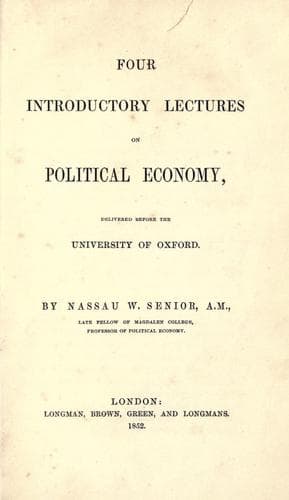
Four Introductory Lectures on Political EconomySenior, Nassau William
General
Four Introductory Lectures on Political Economy
Senior, Nassau William
Economics
The wealth which consists merely of a right or credit on the part of A.
with a corresponding duty or debt on the part of B., is not considered
by the political economist. He deals with the things which are the
subjects of the right or of the credit, not with the claims or the
liabilities which may affect them. In fact, the credit amounts merely
to this, that B. has in his hands a part of the property of A.
I have said that my definition of wealth differs from that which has
been adopted by many of my predecessors. Some political economists
extend the term to all the objects of human desire; others restrict it
to what they have called material products; and others to the things
which cannot be acquired or produced without labour. The objections to
the first definition are obvious. If wealth be the subject of Political
Economy, and wealth include all that man desires, Political Economy,
whether a science or an art, is the science or the art which treats of
human happiness--a subject, as I have already remarked, too extensive
to be included in a single treatise. The second, that which confines
wealth to material objects, is more plausible. It includes all visible
wealth, it includes all wealth which is capable of direct and complete
sale. The things which it excludes are mere objects of the intellect.
They may be shared, but cannot be completely transferred, since the
proprietor, though he may impart them, cannot divest himself of them;
they may produce permanent effects, but perish themselves with the
individual mind of which they are qualities. But as they obey, in other
respects, the same laws as material wealth, are obtained by the same
means, and owe their value to the same causes, I think their exclusion
a fatal objection to a definition of wealth. The definition which
confines wealth to the things which cannot be acquired or produced
without labour, differs little from mine, which confines it to things
limited in supply. Whatever must be obtained by labour is necessarily
limited in supply, the supply of labour itself being limited; and, on
the other hand, there are, in fact, scarcely any, if there be any,
commodities limited in supply and capable of transfer, which can be
obtained without some labour. So that wealth is always found subject
to both these incidents. Nor does value appear to depend on either
incident exclusively. A quarter of corn from the best, and one from
the worst land, of equal goodness, sell in the same market at the same
price, though one may have cost three times as much labour as the
other. The pictures of Hans Hemling are far more limited in supply than
those of Raffaelle, and yet they sell for much less.
Public-domain text, read in full here on John Shaqi.
Reviews
Reviews
No reviews yet
Be the first to share your thoughts on this work.
Join the Discussion
Join the discussion
Sign in to leave a comment or review.
Sign InorCreate an account