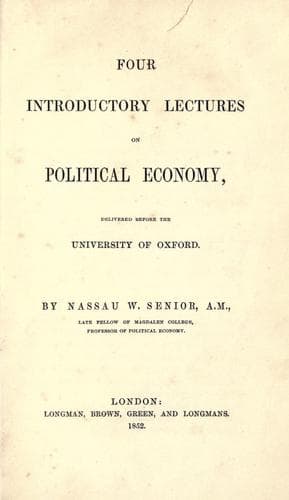
Four Introductory Lectures on Political EconomySenior, Nassau William
General
Four Introductory Lectures on Political Economy
Senior, Nassau William
Economics
and there would then be as much wealth as there was before the change;
probably more, and certainly much more enjoyment. It is probable that
salt forms a smaller part of the wealth of England than of Hindostan,
though every Englishman has twenty times as much of it as every Hindoo.
The Englishman is allowed to use freely the abundant supply offered by
nature. In Hindostan there is a natural scarcity, aggravated tenfold by
the Government.
We may conceive a case in which unlimited abundance would destroy
not only the value, but the utility of a whole class of commodities;
would prevent them not merely from being objects of exchange, but even
from being objects of desire. This would be the case as to all the
commodities whose only utility is to be a means of displaying wealth.
If emeralds were suddenly to become as abundant as pebbles, they could
be no longer used as ornaments; and if no other use could be made of
them, and I am not aware of any, they would be valueless. All their
possessors, at the time of the change, would find themselves poorer,
and neither they nor any one else would be compensated by any increased
means of enjoyment. It would be a mere destruction of wealth.
It may be as well to remark, that things may be wealth to individuals
without forming part of the wealth of the community to which those
individuals belong. This is the case with respect to almost all the
wealth created by an artificial limitation of supply. The monopolies
with which Elizabeth rewarded her favourites were wealth to them, but
diminished the wealth of the rest of the community. The same may be
said of a patent right, or of the secrecy of a manufacturing process.
The process itself, which is protected by the patent or by the secrecy,
is part of the wealth of the community, since it enables them to have
more or better commodities; but the monopoly granted by the patent,
or guarded by the secrecy, is wealth only to its owner. As soon as
the patent terminates, or the secret is divulged, the wealth of the
community is increased by the increased abundance of the commodities to
the production of which every one may now apply the process.
Again, the national debt is wealth to the proprietors of stock, but
as the sum received in dividends is paid in taxes, it cannot form a
part of the wealth of the nation. If, indeed, those two sums precisely
coincided, if there were no expenses of collection, and if taxes did
not interfere with the production of wealth, the national debt would
not diminish the national wealth, though it could not augment it. It
would be a mere matter of distribution. But the expense of collecting
the national revenue, and the interference of taxation with production,
are so much pure loss; and by the amount of these two sources of
expense and loss, we should be richer if the national debt were
repudiated.
Public-domain text, read in full here on John Shaqi.
Reviews
Reviews
No reviews yet
Be the first to share your thoughts on this work.
Join the Discussion
Join the discussion
Sign in to leave a comment or review.
Sign InorCreate an account