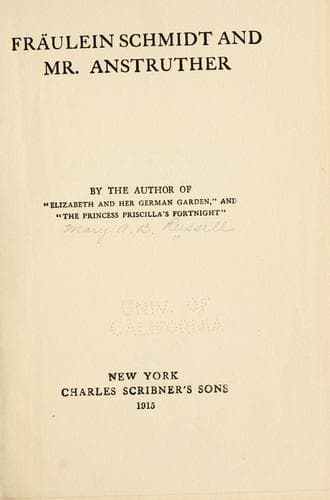
Fräulein Schmidt and Mr. AnstrutherVon Arnim, Elizabeth
General
Fräulein Schmidt and Mr. Anstruther
Von Arnim, Elizabeth
British -- Germany -- Fiction; Epistolary fiction; Germany -- Fiction; Love stories; Young women -- Fiction
It is very bewildering. The advice one gets points in such opposite
directions. For instance, the neighbor made friends the very first
evening with Papa, who walked with injudicious inattention in our garden
and slipped down through a gap in the fence into his orchard and his
arms, he being engaged in picking up the fallen plums for his wife to
make jam of; and he told me when he came in one day at dinner and found
me struggling through what he considered dark ways and I thought were
cabbages, that my salvation lay in almonds. I went down to Jena that
afternoon and bought three pounds of them. They were dear, and
dreadfully heavy to carry up the hill, and when I was panting past the
neighbor's gate his wife, a friendly lady who reads right through the
advertisements in the paper every morning and spends her evenings with a
pencil working out the acrostics, was standing at it cool and
comfortable; and she asked me, with the simple inquisitiveness natural
to our nation, what I had got in my parcel; and I, glad to stop a moment
and get my breath, told her; and she immediately scoffed both at her
husband and at the almonds, and said if I ate them I would lay up for
myself an old age steeped in a dreadful thing called xanthin poison. I
went home and consulted the books. The neighbor's wife was right.
Johanna made macaroons of the almonds, and Papa, who loves macaroons,
chose to disbelieve the neighbor's wife and ate them.
But the books are not always so unanimous as they were about this. One
exhorted us to eat many peas and beans, which we were cheerfully
doing,--for are they not in summer pleasant things?--when I read in
another that we might as well eat poison, so full were they, too, of
qualities ending in xanthin poison. Lentils, recommended warmly by most
books, are discountenanced by two because they make you fat. Rice has
shared the same condemnation. Lettuces we may eat, but without the oil
that soothes and the vinegar that interests, and if you add salt to them
you will be thirsty, and you must never drink. An undressed lettuce--a
quite naked lettuce--is a very dull thing. Really, I would as soon eat
grass. We do refuse at present to follow this cruel advice, and have
salad every day in defiance of it, but my conscience forces me to put
less and less dressing in it each time, hoping that so shall we wean
ourselves from the craving for it--'gradually,' as Papa says. Carrots,
too, the books warn us against. I forget what it is they do to you that
is serious, but the neighbor told me they make your skin shine, and
since he told me that no carrot has crossed our threshold. Apples we may
eat, but we are not to suppose that they will nourish us; they are
useful only for preventing, by their bulk, the walls of our insides from
coming together. The walls of the vegetarian inside are very apt to come
together if the owner strikes out all the things he is warned against
from his menu, and then it is, when they are about to do that, that
Public-domain text, read in full here on John Shaqi.
Reviews
Reviews
No reviews yet
Be the first to share your thoughts on this work.
Elsewhere in the archive
Join the Discussion
Join the discussion
Sign in to leave a comment or review.
Sign InorCreate an account