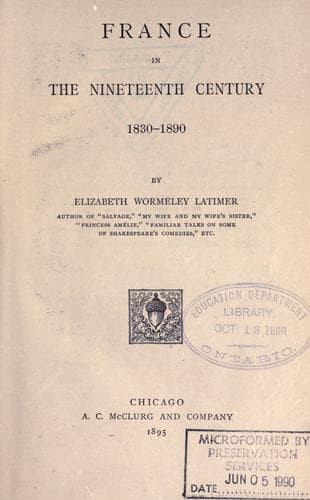
France in the Nineteenth CenturyLatimer, Elizabeth Wormeley
History
France in the Nineteenth Century
Latimer, Elizabeth Wormeley
France -- History -- 1789-1900
The attempt had been in preparation ever since Louis Napoleon had
arrived in England. There were about forty of his adherents living
in London at his expense, awaiting the moment for action. What form
that action was to take, none of them knew.[1] It was resolved to
make the movement in the month of August, 1840. The prince calculated
that the remains of his great uncle, restored by England to France,
being by that time probably on their way from St. Helena, public
enthusiasm for the great emperor would be at its height, and that
he would have the honor of receiving those revered remains when
they had been brought back from exile by Louis Philippe's son.
Besides this, the garrisons of northern France happened at that
moment to contain the two regiments whose fidelity he had tampered
with at Strasburg four years before.
[Footnote 1: In this account I am largely indebted to the interesting
narrative of Count Joseph Orsi, an Italian banker, Prince Louis
Napoleon's stanch personal friend.]
Of course there were French agents of police (detectives, as we
call them) watching the prince in London; and this made it necessary
that he should be very circumspect in making his preparations. A
steamer, the "Edinburgh Castle," was secretly engaged. The owners
and the captain were informed that she was chartered by some young
men for a pleasure-trip to Hamburg.
On Tuesday, Aug. 4, 1840, the "Edinburgh Castle" came up the Thames,
and was moored alongside a wharf facing the custom-house. As soon as
she was at the wharf, Count Orsi, who seems to have been the most
business-like man of the party, shipped nine horses, a travelling
carriage, and a large van containing seventy rifles and as many
uniforms. Proclamations had been printed in advance; they were
placed in a large box, together with a little store of gold, which
formed the prince's treasure.
At dawn all this was done, and the "Edinburgh Castle" started down
the river. At London Bridge she took in thirteen men, and at Greenwich
three more. At Blackwall some of the most important conspirators
came on board. The boat reached Gravesend about two o'clock, where
twelve more men joined them. Only three or four of those on board
knew where they were going, or what was expected of them. They
were simply obeying orders.
At Gravesend the prince was to have joined his followers, and the
"Edinburgh Castle" was at once to have put to sea, touching, however,
at Ramsgate before crossing the Channel. Those on board waited
and waited, but no prince came. Only five persons in the vessel
(one of whom was Charles Thélin, the prince's valet) knew what
they were there for.
Public-domain text, read in full here on John Shaqi.
Reviews
Reviews
No reviews yet
Be the first to share your thoughts on this work.
Join the Discussion
Join the discussion
Sign in to leave a comment or review.
Sign InorCreate an account