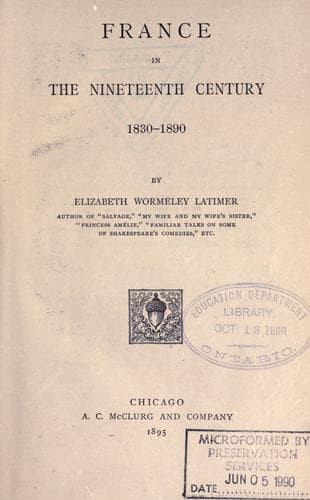
France in the Nineteenth CenturyLatimer, Elizabeth Wormeley
History
France in the Nineteenth Century
Latimer, Elizabeth Wormeley
France -- History -- 1789-1900
The prince hastened with Thélin to the place where the cabriolet
engaged the day before was waiting for them. As Louis Napoleon
was about to fling away the board he had been carrying, another
cabriolet drove by. As soon as it was out of sight, the prince
jumped into his own, shook the dust off his clothes, kicked off
his wooden shoes, and seized the reins. The fifteen miles to St.
Quentin were soon accomplished. The prince got out at some distance
from the town, and Thélin entered it alone, to exchange the cabriolet
for a postchaise. The mistress of the post-house offered him a
large piece of pie, which he thankfully accepted, knowing that it
would be a godsend to his master. A woman, whom they had passed
upon the highway on entering the town, took Thélin aside and asked
him how he came to be driving with such a shabby, common man that
morning; for Thélin was well known in the neighborhood.
Before he rejoined the prince with the pie and the postchaise, Louis
Napoleon had become very impatient. Seeing a carriage approach,
he stopped it, and asked the occupant if he had seen anything of a
postchaise coming from St. Quentin. The traveller proved afterwards
to have been the prosecuting attorney of the district (_le procureur
du roi_).
It was nine in the evening when the prince, Thélin, and the dog
Ham were safely in the carriage. They reached Valenciennes at a
quarter to three A. M., and had to wait more than an hour at the
station for the train. The prince had discarded his working clothes,
but still wore his black wig. The train arrived at last. By help of
the Englishman's passport the prince safely crossed the frontier,
and soon reached Brussels. Thence he went by way of Ostend to London.
He was not in time to see his father, who died in Florence before he
could get permission from the German States to cross the continent.
All the French papers treated his escape as a matter of no consequence.
Immediately on reaching London, he wrote a letter to Louis Philippe,
pledging himself to make no further attempt to disturb the peace
of France during his reign. He probably judged that the end of
the Orleans dynasty might be near.
His escape from prison was not known until the evening. Dr. Conneau
gave out that he had been very ill during the night, but under the
influence of opiates was sleeping quietly. The governor insisted
on remaining all day in the sitting-room, and finally upon seeing
him. In the dim light of the sick chamber he saw only a figure,
with its face turned to the wall, covered up in the bed-clothes.
At last he became suspicious. Thélin's prolonged absence seemed
unaccountable. A closer examination was insisted on, and the truth
was discovered. Nobody was punished except Dr. Conneau, who suffered
a few months' imprisonment.
[Illustration: _LOUIS PHILLIPE_. ("_The Citizen-King._")]
CHAPTER IV.
TEN YEARS OF THE REIGN OF THE CITIZEN KING.
Public-domain text, read in full here on John Shaqi.
Reviews
Reviews
No reviews yet
Be the first to share your thoughts on this work.
Elsewhere in the archive
Join the Discussion
Join the discussion
Sign in to leave a comment or review.
Sign InorCreate an account