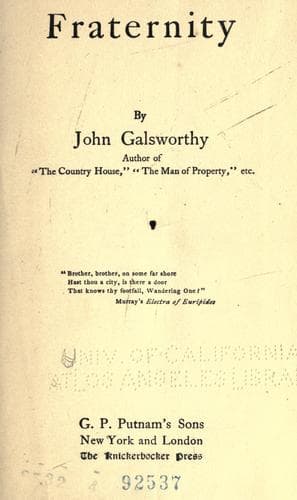
England -- Social life and customs -- 20th century -- Fiction; London (England) -- Fiction; Upper class families -- England -- Fiction
distended. Looking back on that pretty voyage, we see the reason why
those ships were doomed never to move, but, seated on the sea-green
bosom of that sea, to heave up and down, heading across each other's
bows in the self-same place for ever. That reason, in few words, was
this: 'The man who blew should have been in the sea, not on the ship.'”
The droning ceased. Hilary saw that Mr. Stone was staring fixedly at
his sheet of paper, as though the merits of this last sentence were
surprising him. The droning instantly began again: “'In social effort,
as in the physical processes of Nature, there had ever been a single
fertilising agent--the mysterious and wonderful attraction known as
Love. To this--that merging of one being in another--had been due all
the progressive variance of form, known by man under the name of Life.
It was this merger, this mysterious, unconscious Love, which was lacking
to the windy efforts of those who tried to sail that fleet. They were
full of reason, conscience, horror, full of impatience, contempt,
revolt; but they did not love the masses of their fellow-men. They could
not fling themselves into the sea. Their hearts were glowing; but the
wind which made them glow was not the salt and universal zephyr: it was
the desert wind of scorn. As with the flowering of the aloe-tree--so
long awaited, so strange and swift when once it comes--man had yet
to wait for his delirious impulse to Universal Brotherhood, and the
forgetfulness of Self.'”
Mr. Stone had finished, and stood gazing at his visitor with eyes that
clearly saw beyond him. Hilary could not meet those eyes; he kept his
own fixed on the empty cocoa cup. It was not, in fact, usual for those
who heard Mr. Stone read his manuscript to look him in the face. He
stood thus absorbed so long that Hilary rose at last, and glanced into
the saucepan. There was no cocoa in it. Mr. Stone had only made enough
for one. He had meant it for his visitor, but self-forgetfulness had
supervened.
“You know what happens to the aloe, sir, when it has flowered?” asked
Hilary with malice.
Mr. Stone moved, but did not answer.
“It dies,” said Hilary.
“No,” said Mr. Stone; “it is at peace.”
“When is self at peace, sir? The individual is surely as immortal as the
universal. That is the eternal comedy of life.”
“What is?” said Mr. Stone.
“The fight or game between the two.”
Mr. Stone stood a moment looking wistfully at his son-in-law. He laid
down the sheet of manuscript. “It is time for me to do my exercises.” So
saying, he undid the tasselled cord tied round the middle of his gown.
Hilary hastened to the door. From that point of vantage he looked back.
Divested of his gown and turned towards the window, Mr. Stone was
already rising on his toes, his arms were extended, his palms pressed
hard together in the attitude of prayer, his trousers slowly slipping
down.
“One, two, three, four, five!” There was a sudden sound of breath
escaping....
Public-domain text, read in full here on John Shaqi.
Reviews
Reviews
No reviews yet
Be the first to share your thoughts on this work.
Join the Discussion
Join the discussion
Sign in to leave a comment or review.
Sign InorCreate an account