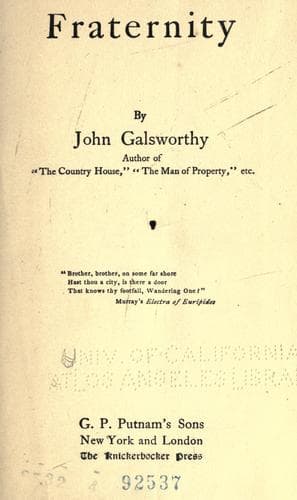
England -- Social life and customs -- 20th century -- Fiction; London (England) -- Fiction; Upper class families -- England -- Fiction
The girl, with a violent effort, finished severing the cheese. The
thin-faced woman took it, and, coughing above it, went away. The girl,
who could not take her eyes off Thyme, now served them with three
pennyworth of bull's-eyes, which she took out with her fingers, for
they had stuck. Putting them in a screw of newspaper, she handed them
to Martin. The young man, who had been observing negligently, touched
Thyme's elbow. She, who had stood with eyes cast down, now turned. They
went out, Martin handing the bull's-eyes to the little girl with an
affection of the skin.
The street now ended in a wide road formed of little low houses.
“Black,” said Martin, “here; all down this road-casual labour,
criminals, loafers, drunkards, consumps. Look at the faces!”
Thyme raised her eyes obediently. In this main thoroughfare it was not
as in the by-street, and only dull or sullen glances, or none at
all, were bent on her. Some of the houses had ragged plants on the
window-sills; in one window a canary was singing. Then, at a bend, they
came into a blacker reach of human river. Here were outbuildings, houses
with broken windows, houses with windows boarded up, fried-fish shops,
low public-houses, houses without doors. There were more men here than
women, and those men were wheeling barrows full of rags and bottles,
or not even full of rags and bottles; or they were standing by the
public-houses gossiping or quarrelling in groups of three or four;
or very slowly walking in the gutters, or on the pavements, as though
trying to remember if they were alive. Then suddenly some young man with
gaunt violence in his face would pass, pushing his barrow desperately,
striding fiercely by. And every now and then, from a fried-fish or
hardware shop, would come out a man in a dirty apron to take the sun and
contemplate the scene, not finding in it, seemingly, anything that in
any way depressed his spirit. Amongst the constant, crawling, shifting
stream of passengers were seen women carrying food wrapped up in
newspaper, or with bundles beneath their shawls. The faces of these
women were generally either very red and coarse or of a sort of
bluish-white; they wore the expression of such as know themselves to be
existing in the way that Providence has arranged they should exist. No
surprise, revolt, dismay, or shame was ever to be seen on those faces;
in place of these emotions a drab and brutish acquiescence or mechanical
coarse jocularity. To pass like this about their business was their
occupation each morning of the year; it was needful to accept it. Not
having any hope of ever, being different, not being able to imagine any
other life, they were not so wasteful of their strength as to attempt
either to hope or to imagine. Here and there, too, very slowly passed
old men and women, crawling along, like winter bees who, in some strange
and evil moment, had forgotten to die in the sunlight of their toil,
Public-domain text, read in full here on John Shaqi.
Reviews
Reviews
No reviews yet
Be the first to share your thoughts on this work.
Elsewhere in the archive
Join the Discussion
Join the discussion
Sign in to leave a comment or review.
Sign InorCreate an account