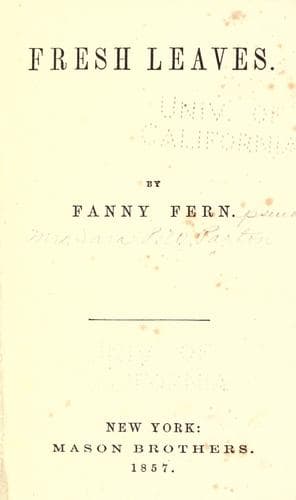
American essays -- 19th century; Short stories, American
“Tut--tut--wife,” said Jacob; “she was not much of a seamstress; you
always had a soft heart, Lucy, and were easily imposed upon by a whining
story.”
“It was too true, Jacob; and she had been dead a whole day before any
one found it out; then, as she had no friends, she was buried at the
expense of the city, and the coffin they brought was too short for her,
and they crowded her poor thin limbs into it, and carried her away in
the poor’s hearse. Sometimes, Jacob, I get very gloomy when I think of
this, and look upon our own beautiful darling; and, sometimes,
Jacob--you won’t be angry with me?” asked the good woman, coaxingly, as
she laid her hand upon his arm--“sometimes I’ve thought our money would
never do us any good.”
“Pshaw!” exclaimed Jacob, impatiently shaking off his wife’s hand;
“pshaw, Lucy, you are like all other women, weak and superstitious. A
man must look out for number one. Small profits a body would make to
conduct business on your principles. Grab all you can, keep all you get,
is every body’s motto; why should I set up to be wiser than my
neighbors?”
Lucy Ford sighed. A wife is very apt to be convinced by her husband’s
reasoning, if she loves him; and perhaps Lucy might have been, had she
not herself known what it was to sit stitching day after day in her
garret, till her young brain reeled, and her heart grew faint and sick,
or lain in her little bed, too weary even to sleep, listening to the
dull rain as it pattered on the skylight, and wishing she were dead.
A pressure of soft lips upon her forehead, and a merry laugh, musical
as the ringing of silver bells, roused Lucy from her reverie.
“Good-by--mother dear,” said Mary; “I could not go to ride with Percy
without a kiss from you. Come to the window--look! Are not those pretty
horses of Percy’s? They skim the ground like birds! And see what a
pretty carriage! Now acknowledge that my lover’s taste is perfect.”
“Yes--when he chose you,” said Jacob, gazing admiringly on Mary’s
bright face and graceful form. “You would grace a court, Mary, if you
are old Jacob Ford’s daughter.”
Mary threw her arms around the old man’s neck, and kissed his bronze
cheek. To her the name of father was another name for love; nurtured in
this kindly atmosphere, she could as little comprehend how a child could
cease to worship a parent, as she could comprehend how a parent, when
his child asked for bread, should mock his misery with a stone.
Unspoiled by the world’s flatteries, she had not learned to undervalue
her doting father’s love, that it was expressed in ungrammatical phrase;
she had not yet learned to blush at any old-fashioned breach of
etiquette (on his part), in the presence of her fastidious young
friends; and by her marked deference to her parents in their presence,
she in a measure exacted the same from them. It was one of the loveliest
traits in Mary’s character, and one for which Percy, who appreciated her
refinement, loved and respected her the more.
Public-domain text, read in full here on John Shaqi.
Reviews
Reviews
No reviews yet
Be the first to share your thoughts on this work.
Elsewhere in the archive
Join the Discussion
Join the discussion
Sign in to leave a comment or review.
Sign InorCreate an account