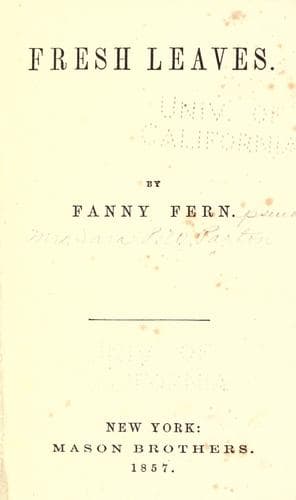
American essays -- 19th century; Short stories, American
“Must topple over, I suppose,” said Percy. “Don’t you believe it, my
angel. I am a living example to the contrary; but Cupid knows I would
subscribe to any article of faith emanating from your rosy lips;” and
Percy drew rein at the door of his father-in-law’s mansion, and leaping
out, assisted Mary to alight.
* * * * *
“Such a lovely drive as we have had, dear mother,” said Mary, throwing
her hat upon the table. “Percy has just gone off with a client on
business; he will be back presently. Dear Percy! he’s just the best
fellow in the world--a little lax on religious points, but he loves me
well enough to be influenced there. Now I will sit down at this window
while I sew, and then I shall see Percy when he comes up the street.”
Nimbly her fingers moved; her merry song keeping time the while. Now a
blush flitting over her cheek, then a smile dimpling it. She was
thinking of their beautiful home that _was_ to be, and how like a fairy
dream her life would pass, with that deep, rich voice lingering ever in
her ear; cares, if they came, lightened by each other’s presence, or
turned to joys by mutual sympathy. And then, she was so _proud_ of him;
A woman’s love is so deepened by that thought.
God pity her, who, with a great soul, indissolubly bound, must walk
ever backward with a mantle (alas! all too transparent), to cover her
husband’s mental nakedness!
CHAPTER II.
“A gentleman, sir, to see you,” said a servant to Jacob Ford, as he
ushered in his old friend, Mr. Trask.
“Ah, Trask, how are you? Glad to see you,” said Jacob, with one of his
vice-like shakes of the hand. “Come for a rubber at whist? That’s right.
I was thinking to-day, how long it was since you and I had a quiet hour
together. How’s trade, Trask? You _ought_ to be making money. Why,
what’s the matter, man?” clapping him on the shoulder; “never saw you
this way before; hang me if you don’t look as solemn as old Parson
Glebe. Why don’t you speak? Why do you stare at me so?”
“Jacob,” replied Mr. Trask, and there he stopped.
“Well--that’s my name; Jacob Ford: as good a name as you’ll find on
’change. I never have done any thing to make me ashamed of it.”
“I wish every body could say as much,” said Trask, gravely.
“What are you driving at?” asked Jacob Ford; “don’t talk riddles to
me--they get me out of temper. If you have any thing to tell, out with
it. I’ve seen fifty years’ wear and tear; I’m not frightened by
trifles.”
“But this is no trifle, Ford. I can’t do it,” said the soft-hearted Mr.
Trask. “Jacob, my old friend--I--can’t do it,” and he sat down and
covered his face with his hands.
“Come--come,” said Jacob; “take heart, man. If you have got into a
scrape, Jacob Ford is not the man to desert an old friend; if a few
hundreds or more will set it all right, you shall have it.”
“For God’s sake, stop,” said Trask; “the shadow has fallen on _your_
threshold, not on _mine_.”
Public-domain text, read in full here on John Shaqi.
Reviews
Reviews
No reviews yet
Be the first to share your thoughts on this work.
Elsewhere in the archive
Join the Discussion
Join the discussion
Sign in to leave a comment or review.
Sign InorCreate an account