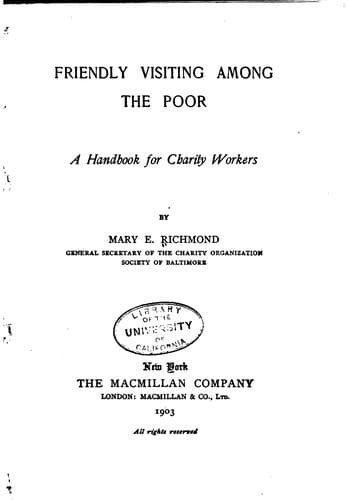
Friendly Visiting among the Poor: A Handbook for Charity WorkersRichmond, Mary Ellen
General
Friendly Visiting among the Poor: A Handbook for Charity Workers
Richmond, Mary Ellen
Friendly visiting
It would be very unfortunate for the visitor to be an alarmist, for
there are imaginary invalids among the poor as well as elsewhere, but
more frequently the poor neglect the earlier symptoms of sickness
altogether, or else dose themselves with patent medicines. The quack
doctors who advertise in the daily papers draw much of their custom
from the very poor, who are also large consumers of cure-alls and
proprietary medicines. We have seen how children's physical defects
can pass unnoticed at home, and this is the case in a less degree with
the defects and ailments of adults. The very cheap grade of medical
service that is sometimes given by regular practitioners in poor
neighborhoods has a tendency to discourage the poor from taking
sickness in time. The visitor can help them to procure better medical
service at reasonable charges or, when necessary, without charge. The
grade of service in dispensaries varies greatly, but the medical advice
and directions given there with the medicines can be made far more
useful if the visitor will go with the patient and see that the
directions are understood and carried {101} out. Often no adult in the
family can spare the time to go with a sick child to the dispensary.
Here, too, the visitor's service will be helpful. In cases of
contagious disease, see that the Board of Health is notified promptly.
Other things being equal, an acute case of illness can usually be
better and more economically cared for in a hospital than in a poor
home. In fact, although hospitals were intended originally for the
destitute sick, the practice of sending well-to-do patients there is
rapidly spreading. The prejudice against hospitals, still so general
among the poor, is a survival from a time when hospital care was far
less humane than now. If the visitor has ever been a patient in a
hospital, and can tell his own experience or the experiences of
friends, or if he happens to know some of the doctors or nurses, and
promises to see them about his poor friend, the prejudice can often be
overcome. The dread of the untried and the unknown is natural enough,
and yet it will happen now and then that hospital care is so clearly
the best thing that nothing can take the place {102} of it, and
suffering and loss will be entailed upon the family by their refusal to
let the sick member go. In such cases charitable people may be
justified in helping the family to a right decision by withholding all
relief.
Public-domain text, read in full here on John Shaqi.
Reviews
Reviews
No reviews yet
Be the first to share your thoughts on this work.
Join the Discussion
Join the discussion
Sign in to leave a comment or review.
Sign InorCreate an account