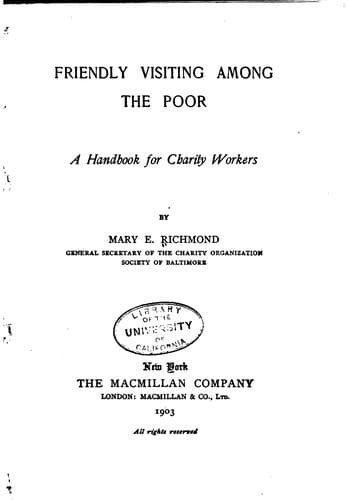
Friendly Visiting among the Poor: A Handbook for Charity WorkersRichmond, Mary Ellen
General
Friendly Visiting among the Poor: A Handbook for Charity Workers
Richmond, Mary Ellen
Friendly visiting
The prejudice against hospitals is strong in the negro race. In the
first family I ever visited the mother, a colored woman, had been
bedridden for thirteen months. According to her own account she had
been "conjured," and at first the mention of a hospital made her
hysterical. She consented to let a doctor, who was a friend of mine,
see her, and he pronounced her disease sciatic rheumatism. He said she
could never get well at home with four small, noisy children, and,
besides, the walls of her house were damp. After two months of
persuading, I got the mother into a hospital and the family moved into
a dry house. Among the arguments that won her were my own acquaintance
with the hospital nurses, and my promise to visit her frequently while
there; and my further promise to see that the children were well cared
for while she was away. But the argument that tipped the scale was the
{103} promise to take her away to the hospital in a carriage with two
horses.
Among the cases in which hospital care is not practicable are those of
chronic invalids, of patients too sick to be moved, and of patients
able to be treated as "out-patients" in the dispensaries. Confinement
cases, where there are children in the family who must be placed
temporarily in institutions if the mother leaves home, are best treated
in the home. There are societies that provide a nurse and baby-linen
at such times. Some families are so degraded that they look forward to
times of confinement as times of plenty (see family cited on p. 55),
and in these cases nothing but hospital care should be offered, while
we place the children temporarily in institutions or with neighbors.
For the destitute sick outside of hospitals, district nurses are now
provided in many cities. When these nurses are careful to instruct
well members of the household in the care of the sick, their influence
is especially helpful, and they are often able not only to relieve
suffering, but to raise the standard of living in the home. Diet
kitchens, supplying food specially {104} prepared for the sick either
free or at a nominal cost, are also found in many of our cities.
With all the charities provided for the sick, there is still need of
better provision in this country for convalescents, who are sent from
the hospitals too weak to resume work, and still needing rest, good
food, and pure air to effect a complete cure.
Public-domain text, read in full here on John Shaqi.
Reviews
Reviews
No reviews yet
Be the first to share your thoughts on this work.
Join the Discussion
Join the discussion
Sign in to leave a comment or review.
Sign InorCreate an account