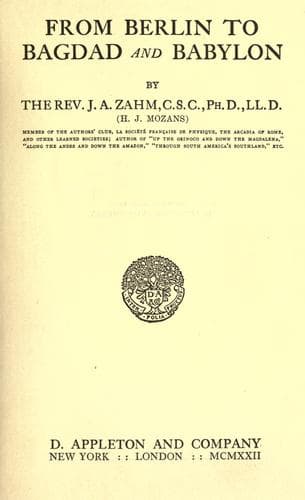
From Berlin to Bagdad and BabylonZahm, J. A. (John Augustine)
HistoryChristian
From Berlin to Bagdad and Babylon
Zahm, J. A. (John Augustine)
Middle East -- Civilization; Middle East -- Description and travel
Scarcely less interesting to me than the age-old remnants of the
Hippodrome were the massive and crumbling walls that for a thousand
years were the city’s palladium against the barbarian hordes of Asia
and Europe. What visions crowd upon the memory as one stands upon
this hoary rampart and surveys the scene around one! It was thanks to
the impregnable walls of Constantinople no less than to the unique
strategic position of the city that Roma Nova was able so long to hold
her place as the home of art and letters, history and philosophy; that,
in spite of desolating wars which everywhere raged in the rest of the
world, and which at times carried their ravaging effects to her very
gates, she continued to be the world’s one sure refuge of law, justice,
and freedom; that, notwithstanding internecine strife, and changes of
dynasties, her government was the one that for centuries afforded the
greatest security for life and property; the one under which commerce
and civilization were most fostered and most flourishing.
If the walls of Constantinople could speak, what thrilling stories
could they not relate of the score of sieges to which they were
exposed! For vivid color and breathless interest they surpass the siege
of Tyre by Alexander, the siege of Carthage by Scipio, the siege of
Jerusalem by Godfrey de Bouillon as described in the glowing epic of
Tasso. Unlike the last-named sieges, those directed against the city
on the Bosphorus “stand out on the canvas of history by the magnitude
of the issues involved to religion, to nations, to civilization.”
This is particularly true of the sieges by Saracens, Turks, and
Mongols, for, if these barbarians and sworn enemies of the Christian
name had succeeded in piercing the walls of this greatest bulwark
of civilization before the dawn of the reconstructive work of the
fifteenth century, the results to learning, art, Christendom would have
been disastrous beyond conception, while progress and social order
would have been retarded for untold centuries.
Never, probably, in the history of our race has the possession of any
city led to more devastating and longer continued wars, to greater
international rivalries and contentions than has the fair capital on
the Golden Horn. It was in 673--but little more than a generation after
Mohammed’s death--when the Moslems under the Saracen Moawiah laid
siege to Constantinople, which was then the greatest and the richest
city of the known world. They were defeated but not crushed. Knowing
the incalculable treasures the city contained and realizing fully its
supreme importance as the center of a world empire, they determined
never to desist from their purpose until Constantinople was the capital
and sovereign seat of Islam. Not until 1453, after eight centuries of
deferred hopes, were their aspirations realized.
Public-domain text, read in full here on John Shaqi.
Reviews
Reviews
No reviews yet
Be the first to share your thoughts on this work.
Join the Discussion
Join the discussion
Sign in to leave a comment or review.
Sign InorCreate an account