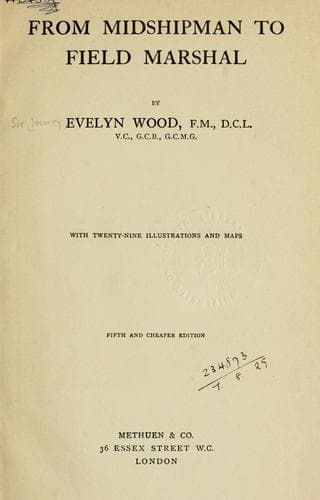
Great Britain -- History, Military -- 19th century; Marshals -- Great Britain -- Biography; Wood, Evelyn, 1838-1919
The storm on the 14th was the commencement of misery so great as to
defy adequate description. Some writers have ascribed the loss of
lives and of health to the climate. This is inaccurate. The climate of
the Crimea, though more variable, is no more inclement than that of
the north of England; moreover, we now know that few men or animals,
with adequate food and suitable clothing, are killed by bad weather,
and as long as they are well fed hard work has little adverse effect
on their health. Officers who were able to procure extra food and
clothing maintained in comparison their health, while the Rank and File
were perishing by hundreds. In eight battalions which served in the
immediate Front with the sailors, 73 men out of every 100 died from
starvation and want of clothing. The weather was indeed deplorable. I
see by my Diary our batteries were flooded on the 27th November, and to
add to the trials of the troops, cholera reappeared on the 2nd December.
Some fresh meat was issued in January and February, but the sick were
always served first, and as the whole quantity available in sixty days
worked out at 14 lbs. a man, with more than half the Army in hospital,
the men still “at duty” had practically none. Moreover, if it had been
issued, there were no means of cooking it; although an Army Order
authorising a ration of fuel was issued in the first week in December,
it was nearly a month before effect could be given to the order. The
troops lived practically on salt meat, biscuit, and rum. They preferred
pork, because it was more easily cooked than what the sailors call
salt-junk, for Chicago beef had not then been canned. Many of the men
could eat neither beef nor pork, for their mouths were affected with
scurvy.
The War Minister wrote in the spring of 1854 to Lord Raglan: “I cannot
help seeing through the calm and noble tone of your announcement of the
decision to attack Sevastopol that it has been taken in order to meet
the views and desires of the Government, and not in entire accordance
with your opinions.” The disaster is summed up in the Report of the
Sevastopol Inquiry Committee presented to the House of Commons in 1855.
The Committee show clearly that “the blame rested on the Ministry, and
on the nation.” The Administration which ordered the expedition had no
adequate information as to the amount of the forces in the Crimea, as
to the strength of the fortresses to be attacked, or of the resources
of the country to be invaded. They did not foresee the probability of a
protracted struggle, and made no provision for a winter campaign.
Public-domain text, read in full here on John Shaqi.
Reviews
Reviews
No reviews yet
Be the first to share your thoughts on this work.
Join the Discussion
Join the discussion
Sign in to leave a comment or review.
Sign InorCreate an account