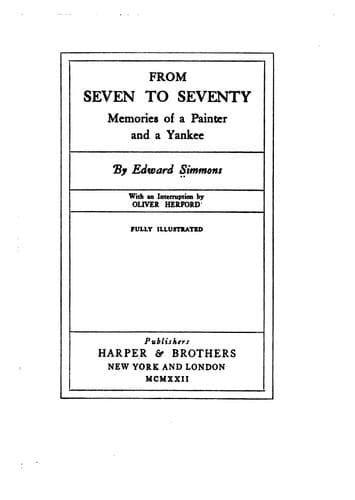
From Seven to Seventy: Memories of a Painter and a YankeeSimmons, Edward
General
From Seven to Seventy: Memories of a Painter and a Yankee
Simmons, Edward
Artists -- Biography
We do not get these sensations often in our lives, and when we do we do
not always recognize what they mean. A Bach prelude in its rhythm,
accord, and beauty of sound; a dancer who at moments seems to reach that
perfect co-ordination of movement and balance; and certain color
combinations—always put a stop to light thinking, and there is—a pause.
If we touch the realm of high beauty, we enter the realm of high
thinking, and no matter if the effect is produced by the hind legs of a
dancer or the thumb of a sculptor, if we get there, we are at the edge
of the goal and something whispers:
“Be careful; tread slowly; you are on sacred ground.”
I had felt and _realized_ my first artistic harmony, and it was in the
realm of color.
The sun was high in the heavens before I began to think of Casey’s
breakfast. Walking out on a huge log that lay across the river and in
some past time had been leveled off, making a bridge wide enough for
horses to pass over, I gazed into the water. It was clear as a crystal
and far down—too far for a line to reach—I could see the lazy fish
moving languorously in their glassy pools. All of a sudden, upon the
improvised bridge, which was decayed and sagged into the water in spots,
appeared a female otter, her coat as sleek as a wet seal’s, her long
tail dragging after her, and in her mouth she held the most beautiful
silver two-pound trout you ever saw. What a perfect breakfast dish!
It all happened in an instant. I was out upon the log with a loud cry
of, “Wow!” The little animal snapped into the water and, before I could
think, the fish, gills between my fingers, was flapping in my hand.
Casey was asleep when I carried the steaming dish and put it under his
nose, crying:
“Wake up, old man! The sun is shining. Here is a king’s breakfast for
you, and to-night you are going to sleep between dry blankets!”
That day, resting much along the way, I carried Henry Casey on my back
five miles to the nearest cabin, belonging to a man named Scott. The
next day he was driven to the stage, went to San Francisco, took the
boat for Panama, and arrived in New York to spend just three weeks with
his family before he died of tuberculosis—not pleurisy.
Sissons was four or five miles from the base of Mount Shasta in
Strawberry Valley, and here it was that I went, after the departure of
Casey. I wanted human companionship and I needed a job. As usual, the
place was named for the first settler; and in this case Sisson was the
hotel proprietor and owner of practically all the worth-while land
about. He was a small man and very pugnacious, but he had been in the
woods for twenty-five years, and that he had managed to keep his
equilibrium for so long was pretty good testimony as to his strong
character. Most everyone went to pieces before that time.
Public-domain text, read in full here on John Shaqi.
Reviews
Reviews
No reviews yet
Be the first to share your thoughts on this work.
Elsewhere in the archive
Join the Discussion
Join the discussion
Sign in to leave a comment or review.
Sign InorCreate an account