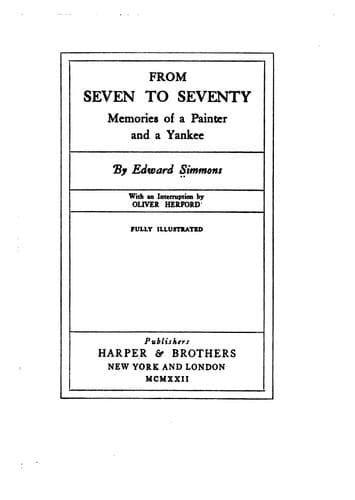
From Seven to Seventy: Memories of a Painter and a YankeeSimmons, Edward
General
From Seven to Seventy: Memories of a Painter and a Yankee
Simmons, Edward
Artists -- Biography
The hotel was the stopping place for teamsters, and very rough. The main
room held a bar, a table for poker, and a fireplace lined always in
winter with these men who drove horses or mules all day and played cards
and told stories all night. As I remember Sisson’s family, it consisted
of his wife; Ivy, about five years old; Joe, of two years—and “Lizzie.”
Lizzie was a short name for “lizard,” and she was taken for granted, the
same as one of the members of the family, by the hotel boarders. They
would speak about her much as if she were a maiden aunt, and she did not
seem to be a particular pet or noticed much. One night a number of these
men were sitting in a circle around the great open fire after supper,
when a man, new to these parts, came in and joined them. They were
chewing tobacco and swapping yarns, when all of a sudden Lizzie ran out
from her hole onto the stones of the hearth and played around
fearlessly, as she did every evening. The new man grunted and, taking
careful aim, spat a squirt of tobacco juice on the little animal.
Instantly the others were upon him. The air was blue with oaths, and he
was punched and clouted ten feet. Ashamed and very much abashed, he
picked himself up without offering any resistance, and the group
reassembled as if nothing had happened. These men did not cease to be
poets just because they carried guns and had never gone to school.
Justice was administered quietly, and each man was his own judge. The
theft of a horse was punishable by death, as a horse meant a man’s whole
existence. I remember a man who lost his brace of mules out of his wagon
as he was sleeping under it. He borrowed a team from Sisson, but
returned them the very next day. He had met the thief on the Ridge and
had calmly shot him.
My duties were varied at Sissons. I was general help on the farm; I
waited on the table at meal time; tended the bar—under which I bunked;
and was village postmaster. In the last capacity it was necessary for me
to get up at four-thirty in the morning, meet the coach, and change the
mails. I shall never forget this. Six feet of snow, the moonlight, and
away down the road, a half mile or more, from amid the great trees came
the weird cry of the stage driver calling for me to get up. Then with
rattle of harness, loud screeching of brakes, the unwieldy vehicle came
to a stop, still swaying and swinging on the leathern supports, like a
ship at sea. And the effect upon the occupants was very much like that
of a sailing vessel. The men rode outside, but if there were women and
children they were within, and the memory of the smell of musty seats,
close air, sweat, and stale vomit that issued forth upon the opening of
the door has remained with me ever since. It was my business to have
whisky ready for these poor, suffering souls, and it was certain that
some of them could not have finished their journey without it.
Public-domain text, read in full here on John Shaqi.
Reviews
Reviews
No reviews yet
Be the first to share your thoughts on this work.
Elsewhere in the archive
Join the Discussion
Join the discussion
Sign in to leave a comment or review.
Sign InorCreate an account