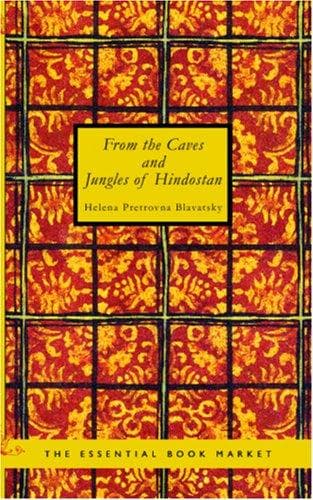
From the Caves and Jungles of HindostanBlavatsky, H. P. (Helena Petrovna)
Religion
From the Caves and Jungles of Hindostan
Blavatsky, H. P. (Helena Petrovna)
Blavatsky, H. P. (Helena Petrovna), 1831-1891; India -- Description and travel; India -- Religion
Next he made his snakes rise on their tails, and, holding the stone
between his first finger and thumb, he proceeded to demonstrate its
influence on the cobras. The nearer his hand approached to the head of
the snake, the more the reptile's body recoiled. Looking steadfastly at
the stone they shivered, and, one by one, dropped as if paralyzed. The
buni then made straight for our sceptical colonel, and made him an offer
to try the experiment himself. We all protested vigorously, but he would
not listen to us, and chose a cobra of a very considerable size. Armed
with the stone, the colonel bravely approached the snake. For a moment
I positively felt petrified with fright. Inflating its hood, the cobra
made an attempt to fly at him, then suddenly stopped short, and, after
a pause, began following with all its body the circular movements of the
colonel's hand. When he put the stone quite close to the reptile's head,
the snake staggered as if intoxicated, its hissing grew weak, its hood
dropped helplessly on both sides of its neck, and its eyes closed.
Drooping lower and lower, the snake fell at last on the ground like a
stick, and slept.
Only then did we breathe freely. Taking the sorcerer aside we expressed
our desire to buy the stone, to which he easily assented, and, to our
great astonishment, asked for it only two rupees. This talisman became
my own property and I still keep it. The buni asserts, and our Hindu
friends confirm the story, that it is not a stone but an excrescence. It
is found in the mouth of one cobra in a hundred, between the bone of the
upper jaw and the skin of the palate. This "stone" is not fastened to
the skull, but hangs, wrapped in skin, from the palate, and so is very
easily cut off; but after this operation the cobra is said to die. If
we are to believe Bishu Nath, for that was our sorcerer's name, this
excrescence confers upon the cobra who possesses it the rank of king
over the rest of his kind.
"Such a cobra," said the buni, "is like a Brahman, a Dwija Brahman
amongst Shudras, they all obey him. There exists, moreover, a poisonous
toad that also, sometimes, possesses this stone, but its effect is much
weaker. To destroy the effect of a cobra's poison you must apply the
toad's stone not later than two minutes after the infliction of the
wound; but the stone of a cobra is effectual to the last. Its healing
power is certain as long as the heart of the wounded man has not ceased
to beat."
Bidding us good-bye, the buni advised us to keep the stone in a dry
place and never to leave it near a dead body, also, to hide it during
the sun and moon eclipses, "otherwise," said he, "it will lose all its
power." In case we were bitten by a mad dog, he said, we were to put the
stone into a glass of water and leave it there during the night, next
morning the sufferer was to drink the water and then forget all danger.
Public-domain text, read in full here on John Shaqi.
Reviews
Reviews
No reviews yet
Be the first to share your thoughts on this work.
Elsewhere in the archive
Join the Discussion
Join the discussion
Sign in to leave a comment or review.
Sign InorCreate an account