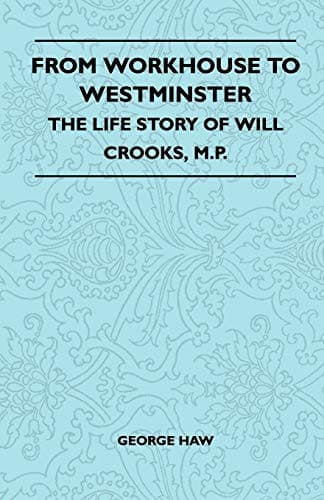
From Workhouse to Westminster: The Life Story of Will Crooks, M.P.Haw, George
History
From Workhouse to Westminster: The Life Story of Will Crooks, M.P.
Haw, George
Crooks, William, 1852-1921; Legislators -- Great Britain -- Biography; Social reformers -- Great Britain -- Biography
The Labour Councillor for Poplar was soon on the warpath again. He
called the Council's attention to the low wages paid to some of the park
attendants. He instanced the man in charge of Red Lion Square, who was
receiving no more than thirteen shillings a week.
"The man's not worth more," shouted a member. "He's got a wooden leg."
"Yes, but he hasn't got a wooden stomach," came the retort from the
Labour Bench.
And the man with the wooden leg, as well as other park attendants, had
their wages brought up to the living standard.
Crooks soon became a good all-round municipal administrator, as well as
a Labour representative. He had stated in his first election address:--
As a workman I should seek especially to represent the interests of
the working classes who form three-fourths of the ratepayers of
Poplar, while giving every attention to the general work of the
London County Council and to the general interests of Poplar.
I am heartily in favour of what is known as the London
programme--of Home Rule for London, as enjoyed by other
municipalities; of the relief of the present ratepayers by taxing
the owner as well as the occupier; and of the equalisation of rates
throughout London for the relief of the poorer districts.
I am in favour of municipal ownership or control of water,
tramways, markets, docks, lighting, parks, and the police.
I would support all measures which would help to raise the standard
of life for the poor, especially in the way of better housing and a
strict enforcement of the Public Health Acts.
Crooks, in fact, became one of the master-builders of the New London
which the L.C.C. created. In face of heavy opposition he was one of that
strenuous band of stalwarts who in the 'nineties raised London out of
the chaos and darkness that reigned before the County Council was called
into being, and gave the capital for the first time a sense of civic
unity.
In later years the claims of Parliament turned much of his energy into
other useful channels. But to this day he still remains a member of the
London County Council, and though now so much engrossed in national
politics, he is none the less proud of his record in the service of
London. He never looks back to the strenuous 'nineties on the County
Council without being thankful.
Public-domain text, read in full here on John Shaqi.
Reviews
Reviews
No reviews yet
Be the first to share your thoughts on this work.
Join the Discussion
Join the discussion
Sign in to leave a comment or review.
Sign InorCreate an account