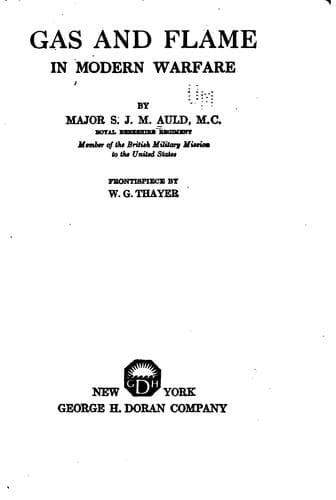
Gas and flame in modern warfareAuld, Samuel James Manson
History
Gas and flame in modern warfare
Auld, Samuel James Manson
Chemical warfare; Flame throwers; Gases, Asphyxiating and poisonous -- War use
It practically came then to this--that protection against the
poison-gas shell was a question of gas-proof dugouts on the one hand
and rapidity of spreading the alarm and quickness of getting protected
on the other. At the gas schools and in the regiments and batteries
men are trained to be so quick in their movements that they can get on
their masks in six seconds. They are also taught on the burst of a gas
shell in their neighbourhood to hold their breath at once. It sounds
easy enough to do this, but it must come to a man automatically in any
circumstances he may happen to find himself--and you can find yourself
in some queer circumstances in war--and to assure this a great deal of
training is needed. Anybody, however, can hold his breath for thirty
seconds, and with practice it is possible to go well over a minute.
During this time it is possible to make a fool of oneself in half a
dozen different ways in putting on a respirator, and yet get it on in
time in the end. But drill sergeants will stand for nothing less than
the standard time and the most meticulous accuracy. God bless these
tyrants--they must have saved a lot of lives! One of the difficulties
we began to encounter with regard to gas shell was the spreading of
the alarm among men on the march or in communication trenches where no
alarm devices are installed. In some battalions it was the custom to
teach men to spread the glad tidings by taking off their steel helmets
and beating them with their bayonets. This certainly makes a good old
noise, but unfortunately it is just when gas shell are coming over that
shrapnel is also likely to be in the air, and to deprive a man of this
tin hat at this time in order to provide him with a gas alarm is rather
robbing Peter to pay Paul.
The best way undoubtedly, and the one now taught throughout the British
and American forces, is to hold the breath, then put on the respirator,
and finally spread the news to everyone else by shouting “Gas shell!”
as loudly as possible with the mask on. In this way the information
can be spread throughout a big working party or from front to rear
of a column of infantry on the march in a remarkably short space of
time. Even in the trenches it is well to give word-of-mouth warning
as well as by means of the local-alarm devices, for a second or two
of absolutely invaluable time may be saved in this way. One soldier
questioned by an officer going the rounds as to what he would do in
the event of a gas shell bombardment replied nervously: “Put on my gas
mask and shout ‘Rattles!’”
Public-domain text, read in full here on John Shaqi.
Reviews
Reviews
No reviews yet
Be the first to share your thoughts on this work.
Elsewhere in the archive
Join the Discussion
Join the discussion
Sign in to leave a comment or review.
Sign InorCreate an account