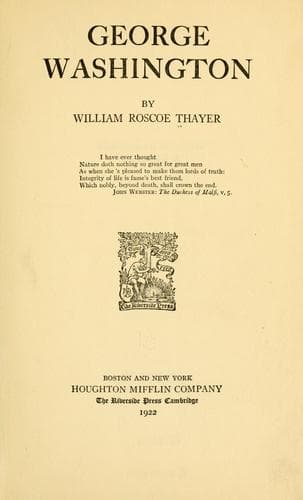
Presidents -- United States -- Biography; Washington, George, 1732-1799
General Washington's interest in their behalf; and that interest of
his seems now one of the noblest and wisest and most patriotic of his
expressions.
Washington had need to be prepared for any emergency. Thus a body
of officers deliberated not only a mutiny of the army, but a _coup
d'état_, in which they planned to overthrow the flimsy Federation of
the thirteen States and to set up a monarchy. They wrote to Washington
announcing their intention and their belief that he would make an
ideal monarch. He was amazed and chagrined. He replied in part as
follows, to the Colonel who had written him:
I am much at a loss to conceive what part of my conduct could have
given encouragement to an address, which to me seems big with
the greatest mischiefs, that can befall my country. If I am not
deceived in the knowledge of myself, you could not have found a
person to whom your schemes are more disagreeable. I must add,
that no man possesses a more sincere wish to see ample justice
done to the army than I do; and, as far as my powers and
influence, in a constitutional way, extend, they shall be employed
to the extent of my abilities to effect it, should there be any
occasion. Let me conjure you, then, if you have any regard for
your country, concern for yourself or posterity, or respect for
me, to banish these thoughts from your mind and never communicate,
as from yourself to any one else, a sentiment of the like
nature.[1]
[Footnote 1: Sparks, 355.]
The turmoil of the army continued throughout the year and into the
next. The so-called "Newburgh Address" set forth the quarrel of the
soldiers and Washington's discreet reply. On April 19, 1783, the
eighth anniversary of the first fighting at Concord, a proclamation
was issued to the American army announcing the official end of all
hostilities. In June Washington issued a circular letter to the
Governors of the States, bidding them farewell and urging them to
guard their precious country. Many of the American troops were allowed
to go home on furlough. In company with Governor Clinton he went up
the Hudson to Ticonderoga and then westward to Fort Schuyler. Being
invited by Congress, which was then sitting at Annapolis, he journeyed
thither. Before he left New York City arrangements were made for a
formal farewell to his comrades in arms. I quote the description of it
from Chief Justice Marshall's "Life of Washington":
Public-domain text, read in full here on John Shaqi.
Reviews
Reviews
No reviews yet
Be the first to share your thoughts on this work.
Elsewhere in the archive
Join the Discussion
Join the discussion
Sign in to leave a comment or review.
Sign InorCreate an account