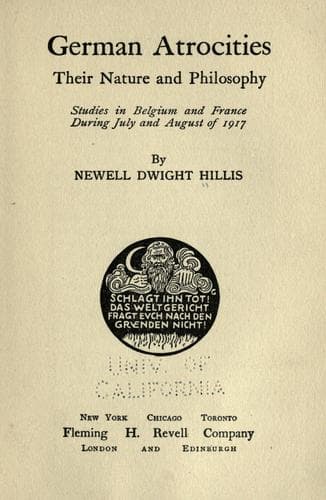
German Atrocities: Their Nature and PhilosophyHillis, Newell Dwight
History
German Atrocities: Their Nature and Philosophy
Hillis, Newell Dwight
Pangermanism; World War, 1914-1918; World War, 1914-1918 -- Atrocities
ever come when the butchers have killed all save one French boy and
girl, when the weapon is lifted against them, they will stand against
the wall of the Pyrenees, and the last Frenchman might die, but he will
never be conquered by the Huns.
THE TRIBUTE OF THE BRITISH
Americans oftentimes marvel at the praise that the British and
the French bestow upon the armies of the other. Each insists upon
considering the other superior to himself. One August day, in a Paris
restaurant, a young English captain, quiet, reserved, modest to a
degree, was praising the French soldiers and officers whom he had met.
Having just returned from the front of Ypres and La Bassée he was
so filled with admiration for the fortitude, the endurance, and the
heroism of the French soldiers, that he sought in vain for words bright
enough with which to describe their achievements. Asked for the reason
of his eulogy, and his conviction as to the supremacy of the French,
the British captain answered, "You must remember that the Frenchman is
fighting for his native land, while England has never been invaded
by the Huns." Then the captain went on to praise the British rifles,
machine guns, their military tactics, and the skill of their soldiers.
"When my company march, they are so perfectly drilled that their one
hundred right legs swing like the single stroke of a pendulum. I will
put my men against the soldiers of the world. Still," he said, "so far
as I now recall, no English division ever brought in at one time more
than one fourth their number as prisoners."
A PICTURE OF THE FRENCH FIGHT
"But," added the captain, "look at the French soldiers at Verdun. One
had a helmet, one a hat, some were bareheaded; some had new rifles,
some old rifles, and some only a bayonet and revolver. When they were
within ten rods of the German trench they lifted up their bayonets and
sent out their battle cry, and hearing the hoarse voices, the Germans
flung away their guns, climbed out of their trenches, ran like rabbits
and bellowed like bulls; that night when the French division came
home for supper, they brought ten thousand Germans along with them.
You can't beat the French--they are fighting for their native land."
That is a reason, but it is not _the_ reason. The reason is this--the
Frenchman counts himself dead already. If he survives to-day's battle,
he says, The morrow will give me another chance to die for God and
beautiful France. The Frenchman never knows when he is defeated, and
therefore he cannot be beaten.
Public-domain text, read in full here on John Shaqi.
Reviews
Reviews
No reviews yet
Be the first to share your thoughts on this work.
Elsewhere in the archive
Join the Discussion
Join the discussion
Sign in to leave a comment or review.
Sign InorCreate an account