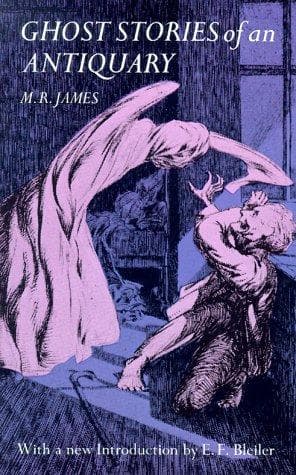
Ghost Stories of an AntiquaryJames, M. R. (Montague Rhodes)
General
Ghost Stories of an Antiquary
James, M. R. (Montague Rhodes)
Ghost stories, English; Horror tales, English; Short stories, English
Of his travels in the North there is no need to speak, nor of his
residence of some weeks in Stockholm. I need only mention that some
_savant_ resident there put him on the track of an important collection
of family papers belonging to the proprietors of an ancient manor-house
in Vestergothland, and obtained for him permission to examine them.
The manor-house, or _herrgård_, in question is to be called Råbäck
(pronounced something like Roebeck), though that is not its name. It is
one of the best buildings of its kind in all the country, and the
picture of it in Dahlenberg’s _Suecia antiqua et moderna_, engraved in
1694, shows it very much as the tourist may see it today. It was built
soon after 1600, and is, roughly speaking, very much like an English
house of that period in respect of material—red-brick with stone
facings—and style. The man who built it was a scion of the great house
of De la Gardie, and his descendants possess it still. De la Gardie is
the name by which I will designate them when mention of them becomes
necessary.
They received Mr Wraxall with great kindness and courtesy, and pressed
him to stay in the house as long as his researches lasted. But,
preferring to be independent, and mistrusting his powers of conversing
in Swedish, he settled himself at the village inn, which turned out
quite sufficiently comfortable, at any rate during the summer months.
This arrangement would entail a short walk daily to and from the
manor-house of something under a mile. The house itself stood in a
park, and was protected—we should say grown up—with large old timber.
Near it you found the walled garden, and then entered a close wood
fringing one of the small lakes with which the whole country is pitted.
Then came the wall of the demesne, and you climbed a steep knoll—a knob
of rock lightly covered with soil—and on the top of this stood the
church, fenced in with tall dark trees. It was a curious building to
English eyes. The nave and aisles were low, and filled with pews and
galleries. In the western gallery stood the handsome old organ, gaily
painted, and with silver pipes. The ceiling was flat, and had been
adorned by a seventeenth-century artist with a strange and hideous
“Last Judgement”, full of lurid flames, falling cities, burning ships,
crying souls, and brown and smiling demons. Handsome brass coronae hung
from the roof; the pulpit was like a doll’s-house covered with little
painted wooden cherubs and saints; a stand with three hour-glasses was
hinged to the preacher’s desk. Such sights as these may be seen in many
a church in Sweden now, but what distinguished this one was an addition
to the original building. At the eastern end of the north aisle the
builder of the manor-house had erected a mausoleum for himself and his
family. It was a largish eight-sided building, lighted by a series of
oval windows, and it had a domed roof, topped by a kind of
pumpkin-shaped object rising into a spire, a form in which Swedish
Public-domain text, read in full here on John Shaqi.
Reviews
Reviews
No reviews yet
Be the first to share your thoughts on this work.
Join the Discussion
Join the discussion
Sign in to leave a comment or review.
Sign InorCreate an account