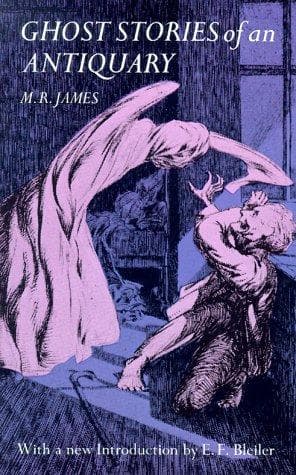
Ghost Stories of an AntiquaryJames, M. R. (Montague Rhodes)
General
Ghost Stories of an Antiquary
James, M. R. (Montague Rhodes)
Ghost stories, English; Horror tales, English; Short stories, English
architects greatly delighted. The roof was of copper externally, and
was painted black, while the walls, in common with those of the church,
were staringly white. To this mausoleum there was no access from the
church. It had a portal and steps of its own on the northern side.
Past the churchyard the path to the village goes, and not more than
three or four minutes bring you to the inn door.
On the first day of his stay at Råbäck Mr Wraxall found the church door
open, and made those notes of the interior which I have epitomized.
Into the mausoleum, however, he could not make his way. He could by
looking through the keyhole just descry that there were fine marble
effigies and sarcophagi of copper, and a wealth of armorial ornament,
which made him very anxious to spend some time in investigation.
The papers he had come to examine at the manor-house proved to be of
just the kind he wanted for his book. There were family correspondence,
journals, and account-books of the earliest owners of the estate, very
carefully kept and clearly written, full of amusing and picturesque
detail. The first De la Gardie appeared in them as a strong and capable
man. Shortly after the building of the mansion there had been a period
of distress in the district, and the peasants had risen and attacked
several châteaux and done some damage. The owner of Råbäck took a
leading part in supressing the trouble, and there was reference to
executions of ring-leaders and severe punishments inflicted with no
sparing hand.
The portrait of this Magnus de la Gardie was one of the best in the
house, and Mr Wraxall studied it with no little interest after his
day’s work. He gives no detailed description of it, but I gather that
the face impressed him rather by its power than by its beauty or
goodness; in fact, he writes that Count Magnus was an almost
phenomenally ugly man.
On this day Mr Wraxall took his supper with the family, and walked back
in the late but still bright evening.
“I must remember,” he writes, “to ask the sexton if he can let me into
the mausoleum at the church. He evidently has access to it himself, for
I saw him tonight standing on the steps, and, as I thought, locking or
unlocking the door.”
I find that early on the following day Mr Wraxall had some conversation
with his landlord. His setting it down at such length as he does
surprised me at first; but I soon realized that the papers I was
reading were, at least in their beginning, the materials for the book
he was meditating, and that it was to have been one of those
quasi-journalistic productions which admit of the introduction of an
admixture of conversational matter.
Public-domain text, read in full here on John Shaqi.
Reviews
Reviews
No reviews yet
Be the first to share your thoughts on this work.
Join the Discussion
Join the discussion
Sign in to leave a comment or review.
Sign InorCreate an account