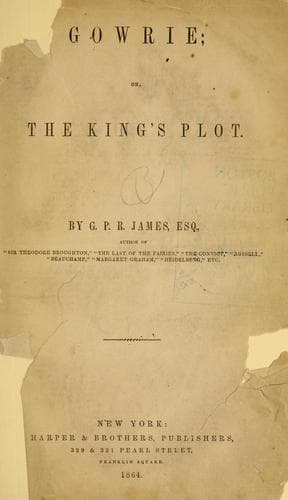
Gowrie; or, the King's Plot.James, G. P. R. (George Payne Rainsford)
General
Gowrie; or, the King's Plot.
James, G. P. R. (George Payne Rainsford)
Gowrie Conspiracy, 1600 -- Fiction
"But you could not, my dear sir," said Lord Gowrie; "depend upon it,
Rhind, there is no striving against woman, circumstances, or an
innkeeper's bill; and it is only waste of words and time to contest a
point with either."
"I am sorry you find it so, my dear lord," replied Mr. Rhind, somewhat
tartly, for he had been rather hardly pressed by his young companions'
gay humour during the morning. Lord Gowrie only laughed, however, for
his heart was very light. He was returning to her he loved; he had
known few sorrows since his very early years, and each step of his
horse's foot seemed, to hope and fancy, to bring him nearer to
happiness. He could have jested at that moment good-humouredly with a
fiend; and certainly Mr. Rhind did not deserve that name. The young
earl, however, saw clearly that his former preceptor was somewhat
annoyed, and he consequently changed the subject, stretching out his
hand, and saying, "Behold the mighty Po. I know not how it is, but
this river, about the part where we are now, though less in course and
in volume than either the Rhine, the Rhone, or the Danube, always
gives me more the idea of a great river than they do. Perhaps it may
be even from the lack of beautiful scenery. With the others we lose
the grandeur of the river in the grandeur of its banks. Here the broad
stream comes upon us in the dead flat plain, without anything to
distract the attention or engage the eye. I am inclined to believe
that a river, as a river, is always more striking when there is no
other great object to be seen."
"And yet to me," said Hume, "the ocean itself, simply as the ocean,
without storms to lash it into magnificent fury, or rocky shores to
hem it in, like a defending and attacking army, but seen from a plain
sandy shore upon a calm day, is not half so sublime a sight as poets
and enthusiasts would have us believe. There is a great deal of
quackery in poetry, don't you think so, Gowrie? Poets bolster
themselves and one another up with associations and images, till they
believe things to be very sublime, which abstractedly are very
insignificant. I remember once standing upon a low beach, and putting
the whole sea out, by holding up a kerchief at arm's length. I have
never since been able to think it sublime except during a storm."
"Take care how you try other things by such standards," said Gowrie;
"I am afraid, my dear Hume, that the same kerchief would have equally
reduced the finest, the noblest, and the best of all the things of
earth. It is he who extends his vision, not he who contracts it, that
learns to judge things most finely, and also, I believe, most really."
Public-domain text, read in full here on John Shaqi.
Reviews
Reviews
No reviews yet
Be the first to share your thoughts on this work.
Elsewhere in the archive
Join the Discussion
Join the discussion
Sign in to leave a comment or review.
Sign InorCreate an account