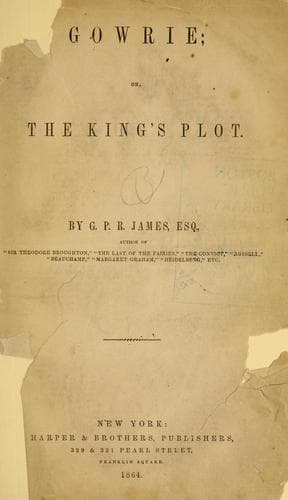
Gowrie; or, the King's Plot.James, G. P. R. (George Payne Rainsford)
General
Gowrie; or, the King's Plot.
James, G. P. R. (George Payne Rainsford)
Gowrie Conspiracy, 1600 -- Fiction
His two young companions only laughed, teazing him a little with
regard to his fears, for they were at that age when a portion of
danger is the sauce of life, giving a higher flavour to enjoyment. The
boatmen assured the old gentleman that the storm would not come till
evening; and away they went down the full quick stream, having for the
first half hour the same hot and glaring sun above them, shining with
undiminished force through the thin haze which lay upon the landscape.
If they expected to find fresher air upon the water they were
mistaken, for not a breath of wind rippled the current of the stream,
and the reflection of the light from its broad glassy current rendered
the heat more intense and scorching than on the land. Sir John Hume
amused himself by taking Mr. Rhind to task for the bad success of his
plan; but Lord Gowrie good-humouredly remarked, that at all events
they were saved the trouble of riding. The boat dropped down the
stream more rapidly than usual, for there was a large body of water in
the river at the time, and the current was exceedingly fierce; but at
the end of about a quarter of an hour the wind suddenly changed to the
southeast, and blowing directly against the course of the eager
waters, tossed them into waves as if on the sea. The change was so
sudden--from almost a perfect calm, with the bright smooth glassy
river hastening on unrippled towards the Adriatic, to a gale of wind
and a wild fierce turbulent torrent--that good Mr. Rhind was nearly
thrown off his seat, and showed manifest symptoms of apprehension. The
boatmen showed no alarm, however, and Lord Gowrie and Sir John Hume
contented themselves with looking up towards the sky, which in the
zenith was becoming mottled with gray and white, while to windward
some heavy black masses of cloud were seen rising rapidly in strange
fantastic shapes. The air was as sultry as before, however, and after
blowing for about a quarter of an hour sufficiently hard to retard the
progress of the travellers very much, the wind suddenly fell
altogether, and a perfect calm succeeded. The waters of the river
still remained as much agitated as ever, and Lord Gowrie called the
attention of Hume to a very peculiar appearance in the sky to the
south.
"Do you see that mass of leaden gray cloud, Hume?" he said, "lying
upon the black expanse behind. See how strangely it twists itself into
different forms, as if torn with some mortal agony."
"Agony enough," answered Sir John Hume, "for the poor cloud looks as
if it had the cholic; but I have remarked that it always is so when
the wind is in the southeast. We shall see presently if there be
thunder or anything else, for it is nothing strange to witness a
conflict of the elements at this season of the year, especially in
this dry and arid country, where the sun seems to reign supreme,
without one green blade of grass to refresh the eye, or one cheering
sound to raise a heart not utterly deprived of feeling for its fellow
creatures."
Public-domain text, read in full here on John Shaqi.
Reviews
Reviews
No reviews yet
Be the first to share your thoughts on this work.
Elsewhere in the archive
Join the Discussion
Join the discussion
Sign in to leave a comment or review.
Sign InorCreate an account