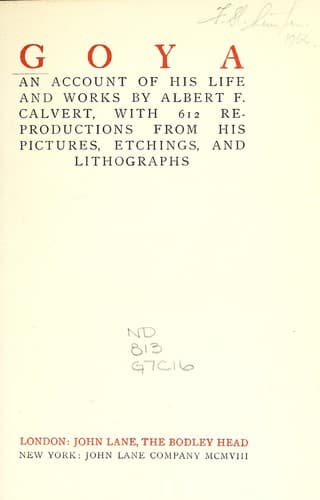
Goya, an account of his life and worksCalvert, Albert Frederick
History
Goya, an account of his life and works
Calvert, Albert Frederick
Goya, Francisco, 1746-1828
In this period of his greatest prosperity, Goya was courted not only for
the sake of his art, but also for his personal qualities. He was popular
with men, while women eagerly contended for his favour. A revolutionary,
he became the friend of the King, while the Queen and the Countess of
Benavente delighted in his companionship. He went from palace to palace
and from fête to fête, observing, working, studying, revelling in the
life by which he was surrounded and in which he played a full part. This
lover of freedom could breathe in an atmosphere of corruption; this son
of the soil could play the courtier with a will. ‘If we are to
understand his genius rightly,’ says C. Gasquoine Hartley, in _A Record
of Spanish Painting_, ‘all contradictions are solved when we realise
that he was an onlooker at, rather than an operator in, many incidents
of his life.’ This half-hearted attempt to condone the irregularity of
his life at this period is at variance both with what we know of Goya’s
temperament and with the facts. He was an actor as well as an
interpreter of the scenes which he represents, and many of his pictures,
which are regarded as biting satires of the follies and vice of his age,
are quite as plausibly explained as the expression of personal animus
and party feeling. Certain people have discovered in Goya a moralist
after the style of Hogarth, using his brush in the sacred cause of
morality, to expose the vices of his time, laying bare the baseness of
his contemporaries in order to inspire contempt and horror of their
conduct, stigmatising the habits of the court of Charles IV., and
castigating the hypocrisy, ignorance, and immodesty of the men and women
who surrounded the royal family. But while in the later works of his
mature age he employed his brush and needle to this purpose, it is more
probable, as Lafond concludes, that under Charles IV. and Maria Luisa,
Goya drew and engraved, as La Fontaine wrote his fables: for the
pleasure of producing them, from the necessity of multiplying them, not
troubling himself about questions of morality or of the lessons which
his pictures should teach. ‘The truth is,’ says his French biographer,
‘that, mixed up in the intrigues of the Court and involved in personal
quarrels, he takes the part now of one, now of another, using his pen to
scratch his adversaries of to-day who are his allies to-morrow.’ In all
his works he imbued the subject with the quality of his thought as well
as with the charm of his colour and the skill of his draughtmanship. Of
all the artists of his class, says the _Boletin de la Sociedad Española
de Excursiones_, none put into their studies more meaning and personal
opinion. If he painted a scene he attached to it a proverb or a
significant ejaculation; if he produced a portrait he left upon the
likeness his opinion of his model; if in many cases it amounted to a
positive caricature, he could no more help seeing his subject in that
Public-domain text, read in full here on John Shaqi.
Reviews
Reviews
No reviews yet
Be the first to share your thoughts on this work.
Join the Discussion
Join the discussion
Sign in to leave a comment or review.
Sign InorCreate an account