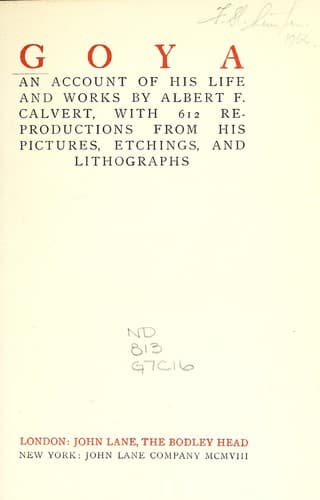
Goya, an account of his life and worksCalvert, Albert Frederick
History
Goya, an account of his life and works
Calvert, Albert Frederick
Goya, Francisco, 1746-1828
The scandal which associated Goya’s name with that of the Duchess of
Alba, fanned, it may be suspected, by the jealousy of the Countess of
Benavente, could not be concealed, and by the order of Maria Luisa, the
Duchess was banished in 1795 to the seclusion of her estate at San
Lucar. The painter immediately obtained from the King a prolonged leave
of absence and accompanied her into exile. On the journey to San Lucar
an accident happened to their carriage, and Goya with his characteristic
energy set to work to repair the defect. An iron bar belonging to the
coach was buckled; a fire had to be lighted and the iron made straight.
The heat and the unwonted exertion which the operation entailed was
followed by a chill, and from this chill resulted the deafness which, in
later years, became complete. The Duchess was recalled in the following
year--this exercise of royal clemency being apparently the only means of
securing the return of the painter to Madrid--and died in the same year
in the fullness of her exquisite and inspiring beauty.
The period of Goya’s greatest popularity (1780-1800) was the period of
his greatest activity. He was high in the favour of the Court. Much of
his time was absorbed in painting portraits of his royal and
aristocratic patrons. At the same time he never lost touch with the
commonalty, nor his powers to depict, with sympathy and understanding,
the life of the country--the bustling, laughing, loving, wrangling,
vibrating life he loved and to which, by birth and temperament, he
belonged. It is probable that he was never a courtier at heart. His
effrontery and uncompromising independence, combined with incisive wit
and physical strength, made him at once a singular and incongruous but
popular figure in the Court circles, while his frank _camaraderie_ and
his amazing prowess in the national games and feats of strength, and
above all, the boldness and skill of his demeanour in the bull-ring--in
which he is said to have been the equal of the professional espada--won
for him the enthusiastic admiration of the hero-worshipping people of
Madrid. He seems to have been at no pains to disguise the real bent of
his nature. The story runs that he would frequently leave the royal
palace to pass the night in the most disreputable taverns and bodegas in
the suburbs of Madrid, drinking, dicing, and merrymaking with the
night-birds of the capital.
Public-domain text, read in full here on John Shaqi.
Reviews
Reviews
No reviews yet
Be the first to share your thoughts on this work.
Join the Discussion
Join the discussion
Sign in to leave a comment or review.
Sign InorCreate an account