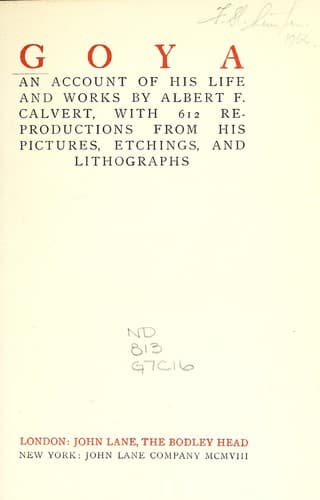
Goya, an account of his life and worksCalvert, Albert Frederick
History
Goya, an account of his life and works
Calvert, Albert Frederick
Goya, Francisco, 1746-1828
The painting of the frescoes of San Antonio de la Florida won for Goya,
as we have seen, the coveted office of first painter to the Court. It
was at this same time he began to paint less and to take up the needle
as a new force of expression. His first work was the series of designs
known as ‘Los Caprichos’ in which the spectator is transported into some
‘unheard of, impossible, but still real world’--a world peopled with
dapper _majas_, handsome hidalgos, hideous old men and hags more
horrible than the witch of Endor, gluttonous priests, spectres and
sorceresses, devils and desperadoes and corpses, all the myriad
diabolical and terrifying shapes and phantasies in which Goya set down
his vision of humanity. The origin, the inspiration and the object of
these etchings are still matters of speculation. It is generally agreed
that the painter executed the first drafts for these plates after his
return from San Lucar. His deafness aggravated by a serious illness,
from which he made a slow and painful recovery, obliged him to give up
the fatiguing work with palette and brush, and it may well be that he,
whose spirit never rested and whose hand was never idle, fell into a
habit of preserving his impressions on paper in order to distract his
tormented imagination from brooding over his sufferings. It was at a
later date that he transferred these drawings on to the copper plates.
It may be reasonable to assume, as some have done, that the part of
philosopher which he had developed leisurely during his days at Court,
as well as the vein of moralist and castigator of vice, was quickened in
him by satiety and physical pain. The Conde de la Viñaza appears to
believe that Goya suddenly awakened to his power as a caricaturist, and
that, irritated at the moral ugliness of his contemporaries, and at the
vile coterie which surrounded the King and Queen, he began to inveigh
unflinchingly against lasciviousness, covetousness, rapacity, hypocrisy,
and ignorance, against the court parasite and the court harlot, the
miser and the monk, the women who sold their daughters and the monsters
who bought them, against insolent pomp, ecclesiastical rottenness and
venal stupidity. Yet probably the view of Gautier is nearer the truth.
He assumes that the now popular painter was ‘merely producing so many
capricious sketches, when he was in truth drawing the portrait and
writing the history of Spain of former days, under the belief that he
was serving the ideas and creed of modern times. His caricatures will
soon be looked upon in the light of historical monuments.’
Public-domain text, read in full here on John Shaqi.
Reviews
Reviews
No reviews yet
Be the first to share your thoughts on this work.
Elsewhere in the archive
Join the Discussion
Join the discussion
Sign in to leave a comment or review.
Sign InorCreate an account