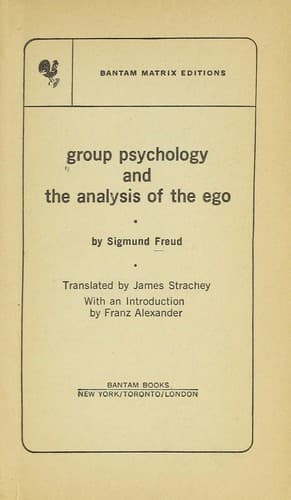
Group Psychology and The Analysis of The EgoFreud, Sigmund
Science
Group Psychology and The Analysis of The Ego
Freud, Sigmund
Ego (Psychology); Psychoanalysis; Social psychology
sentimental way, who crowd round a singer or pianist after his
performance. It would certainly be easy for each of them to be jealous
of the rest; but, in face of their numbers and the consequent
impossibility of their reaching the aim of their love, they renounce it,
and, instead of pulling out one another's hair, they act as a united
group, do homage to the hero of the occasion with their common actions,
and would probably be glad to have a share of his flowing locks.
Originally rivals, they have succeeded in identifying themselves with
one another by means of a similar love for the same object. When, as is
usual, a situation in the field of the instincts is capable of various
outcomes, we need not be surprised if the actual outcome is one which
involves the possibility of a certain amount of satisfaction, while
another, even though in itself more obvious, is passed over because the
circumstances of life prevent its attaining this aim.
What appears later on in society in the shape of _Gemeingeist_, _esprit
de corps_, 'group spirit', etc., does not belie its derivation from what
was originally envy. No one must want to put himself forward, every one
must be the same and have the same. Social justice means that we deny
ourselves many things so that others may have to do without them as
well, or, what is the same thing, may not be able to ask for them. This
demand for equality is the root of social conscience and the sense of
duty. It reveals itself unexpectedly in the syphilitic's dread of
infecting other people, which psycho-analysis has taught us to
understand. The dread exhibited by these poor wretches corresponds to
their violent struggles against the unconscious wish to spread their
infection on to other people; for why should they alone be infected and
cut off from so much? why not other people as well? And the same germ is
to be found in the pretty anecdote of the judgement of Solomon. If one
woman's child is dead, the other shall not have a live one either. The
bereaved woman is recognized by this wish.
Public-domain text, read in full here on John Shaqi.
Reviews
Reviews
No reviews yet
Be the first to share your thoughts on this work.
Join the Discussion
Join the discussion
Sign in to leave a comment or review.
Sign InorCreate an account