Group Psychology and The Analysis of The Ego — John Shaqi
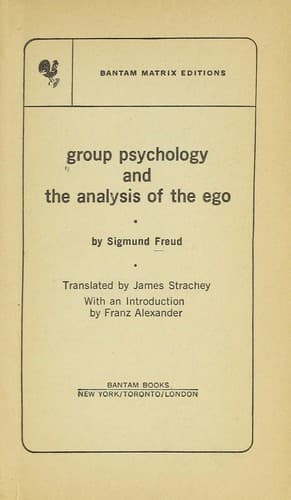
Group Psychology and The Analysis of The EgoFreud, Sigmund
Science
Group Psychology and The Analysis of The Ego
Freud, Sigmund
Ego (Psychology); Psychoanalysis; Social psychology
Thus social feeling is based upon the reversal of what was first a
hostile feeling into a positively-toned tie of the nature of an
identification. So far as we have hitherto been able to follow the
course of events, this reversal appears to be effected under the
influence of a common tender tie with a person outside the group. We do
not ourselves regard our analysis of identification as exhaustive, but
it is enough for our present purpose that we should revert to this one
feature--its demand that equalization shall be consistently carried
through. We have already heard in the discussion of the two artificial
groups, church and army, that their preliminary condition is that all
their members should be loved in the same way by one person, the leader.
Do not let us forget, however, that the demand for equality in a group
applies only to its members and not to the leader. All the members must
be equal to one another, but they all want to be ruled by one person.
Many equals, who can identify themselves with one another, and a single
person superior to them all--that is the situation that we find realised
in groups which are capable of subsisting. Let us venture, then, to
correct Trotter's pronouncement that man is a herd animal and assert
that he is rather a horde animal, an individual creature in a horde led
by a chief.
X
THE GROUP AND THE PRIMAL HORDE
In 1912 I took up a conjecture of Darwin's to the effect that the
primitive form of human society was that of a horde ruled over
despotically by a powerful male. I attempted to show that the fortunes
of this horde have left indestructible traces upon the history of human
descent; and, especially, that the development of totemism, which
comprises in itself the beginnings of religion, morality, and social
organisation, is connected with the killing of the chief by violence and
the transformation of the paternal horde into a community of
brothers.[53] To be sure, this is only a hypothesis, like so many others
with which archaeologists endeavour to lighten the darkness of
prehistoric times--a 'Just-So Story', as it was amusingly called by a
not unkind critic (Kroeger); but I think it is creditable to such a
hypothesis if it proves able to bring coherence and understanding into
more and more new regions.
Public-domain text, read in full here on John Shaqi.
Reviews
Reviews
No reviews yet
Be the first to share your thoughts on this work.
Join the Discussion
Join the discussion
Sign in to leave a comment or review.
Sign InorCreate an account